
Understanding Your SoftSpot® Report
A guide for parents on how to interpret Cranial Index (CI) and Cranial Vault Asymmetry Index (CVAI).
For how each number is measured in the first place, read how a baby's head shape is measured.
Want expert guidance?
Connect with a qualified pediatric provider to discuss your baby’s results and discuss next steps.
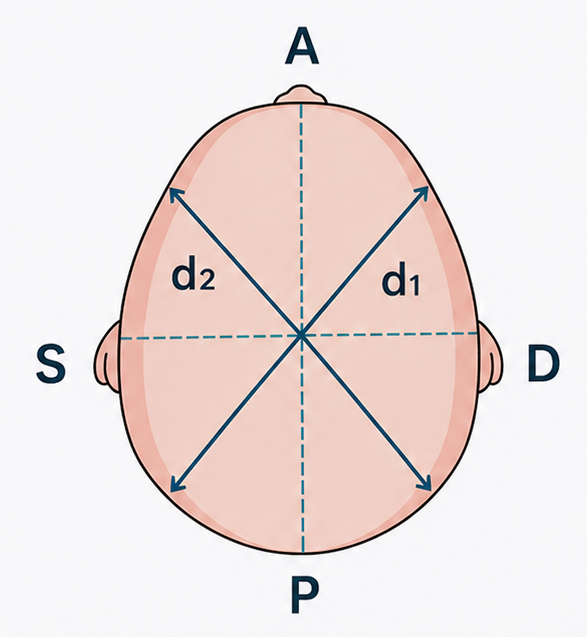
Here are the definitions:
(CRANIAL INDEX)
(CRANIAL VAULT ASYMMETRY INDEX)
AP is the line defined by the nose tip (A) and the center of the mass of the head contour.
SD is the line side-to-side perpendicular to AP.
d1 and d2 are the diagonals.
A difference between d1 and d2 indicates asymmetry.
CI (Cranial Index)
Shows how wide vs. long the head is. This determines the overall head shape.
CVAI (Cranial Vault Asymmetry Index)
Shows how symmetrical the head is (left vs. right). This identifies if one side is flatter than the other.
Helps identify if a head is disproportionately wide (Brachycephaly) or long (Scaphocephaly). Published CI ranges differ between clinics, devices and studies, so ask which reference your provider uses.
Identifies "flat spots" on one side, commonly known as Plagiocephaly.
What these numbers help identify
Common conditions specialists look for in reports.


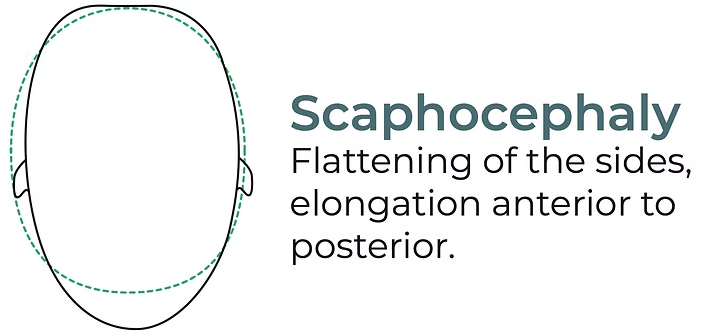
CHOA guideline on severity scale:
Refer to the Children's Healthcare of Atlanta (CHOA) severity scale guidelines for detailed clinical context regarding head shape measurements.
View CHOA GuidelineHow accurate is SoftSpot?

SoftSpot is FDA-cleared for the measurement of CI and CVAI in infants from 1 month to 2 years of age.
For more detailed information, we recommend referring to the FDA 510(k) summary for SoftSpot on the FDA website which outlines the validation and intended use.
View FDA 510(k) SummaryReliable for Everyone
Clinical accuracy is maintained regardless of who takes the photo—whether it's a parent, a caregiver, or a lay user.
The Standard of Care
Caliper measurement is the clinical standard of care. Now, parents can achieve that same accuracy at home.
Want expert guidance?
Connect with a qualified pediatric provider to discuss your baby’s results and discuss next steps.