
Parent guide to DentSpot™
What Is DentSpot? AI Photo Screening for Your Child's Bite
DentSpot is a free tool that looks at phone photos of a child's teeth and points out patterns worth asking a dentist about: upper front teeth that stick out, a lower jaw that sits back, or teeth that are out of line. Here is what it does, what the research behind it shows, and why the timing of a bite check matters.
Reviewed by the SoftSpot Clinical & Scientific Team
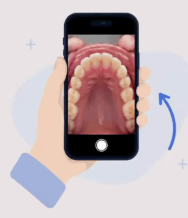
What DentSpot does
DentSpot is one of the free screening tools on SoftSpot Connect, alongside EarSpot, NeckSpot, and ScolioSpot. It is built by PediaMetrix, the team behind the SoftSpot head-shape measurement app.
You photograph your child's teeth from up to five guided angles, or upload photos you already have. An AI model trained on pediatric intraoral photographs looks at each visible tooth and labels it with one of four categories. The labeled photos come back as a visual summary that you can keep, export as a PDF, or bring to a dental appointment.
The point is not to replace a dental exam. It is to turn "something looks a bit off" into a clear set of photos and a specific question, such as "do her top teeth stick out more than they should?"
The four patterns DentSpot looks for
Each label describes how a tooth or group of teeth appears in a photo. Different views can show different labels for the same child, which is expected.
Healthy Teeth
The visible teeth did not resemble any of the three flagged patterns the model was trained on. It is not a clean bill of dental health; it simply means none of those specific patterns were found in the photos provided.
Mandibular retrusion
The lower jaw appears to sit further back than usual relative to the upper jaw. From the side, the chin and lower teeth can look set back. This is one of the visible markers associated with a skeletal Class II growth pattern.
Deep overjet
The upper front teeth sit noticeably ahead of the lower front teeth, front to back. Parents often call this “buck teeth” or an overbite. Prominent upper front teeth are also more exposed to injury in falls and sports.
Tooth misalignment
Teeth look crowded, rotated, spaced, or out of line with their neighbors. Misalignment is common while baby teeth are being replaced and is not always a sign of a jaw-growth issue.
DentSpot only knows these four categories. It does not look for cavities, gum disease, crossbites, open bites, underbites, or missing teeth, so those can be present even when it reports Healthy Teeth.
Why overjet and a set-back jaw get extra attention
Dentists describe bites by how the upper and lower teeth meet. In a Class II bite, the lower teeth and jaw sit behind where they would normally be relative to the upper teeth. Some Class II bites come mainly from tooth position; others come from how the jaws themselves are growing, which is called a skeletal Class II pattern.
Two of DentSpot's categories, mandibular retrusion and deep overjet, are photographic signs that can go along with a skeletal Class II pattern. That is why the DentSpot research gave them particular attention: they are the findings where an earlier conversation with an orthodontist may matter most.
Jaw growth has a timeline. Orthodontists can use growth-guiding appliances to help address a Class II jaw relationship, and a systematic review found the effect on lower-jaw growth tends to be larger when treatment is timed around the pubertal growth spurt.
Once growth is complete, correcting a significant jaw difference can require more involved treatment. Not every child with a Class II bite needs early treatment, and a Cochrane review found the clearest benefit of starting early for prominent upper teeth was a lower risk of injury to those teeth. Deciding whether and when to treat is the orthodontist's job; noticing the pattern in time to ask is where a parent can help.
Traditionally, jaw-growth patterns are assessed with a side-view X-ray of the head (a cephalometric radiograph), taken in a dental or orthodontic office. Photos cannot replace that, but they are free, radiation-free, and can be taken at home, which is what makes them useful as a first look.
How to take DentSpot photos
DentSpot accepts up to five views, and you can run it with fewer. More views give a fuller picture, since each angle shows different teeth. An on-screen outline helps you line up each shot.
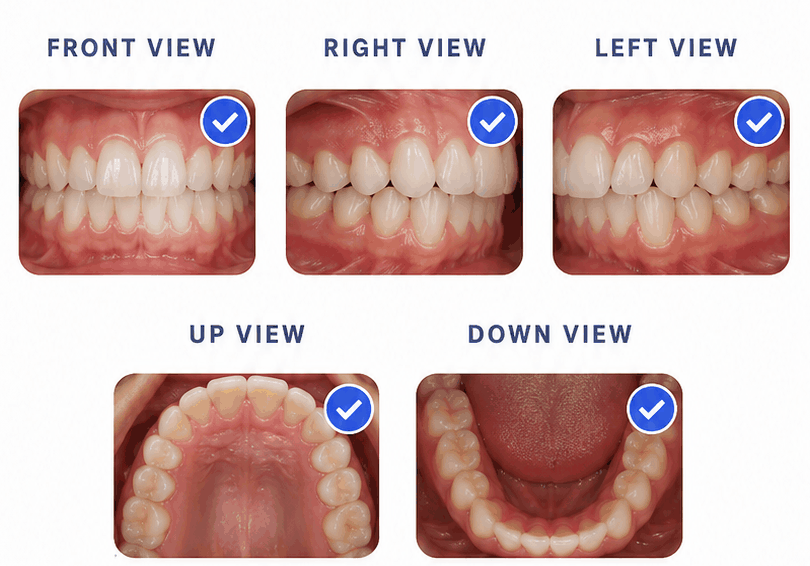
- Front: Teeth gently together, lips pulled back, camera straight on.
- Right: Teeth together, camera at the right side of the mouth.
- Left: Teeth together, camera at the left side of the mouth.
- Up: Mouth wide open, showing the biting surfaces of the upper teeth.
- Down: Mouth wide open, showing the biting surfaces of the lower teeth.
- Use bright, even light. A window or a second phone's flashlight helps more than the camera flash.
- Gently pull the lips and cheeks back with clean fingers, or use a child-size cheek retractor if you have one.
- Keep the phone level with the teeth rather than shooting from above.
- Retake blurry or partly hidden shots. A clear photo is worth more than a fast one.
How to read the result
Look for consistency. A side view may show jaw position more clearly, while the front view may make spacing or overjet easier to see. If the same pattern shows up across several views, that is a clearer reason to share the photos with a dentist than a single label on one photo.
A flagged label is a prompt for a question, not an answer. Teeth shift a great deal while baby teeth are replaced, and some patterns that look striking at age 7 settle by themselves. Equally, a Healthy Teeth result does not rule out a bite issue that is hard to see in photos.
When you bring the result to an appointment, say what you noticed at home, when you first noticed it, and whether anyone in the family has had orthodontic treatment for a similar bite.
What the research shows so far
DentSpot was developed and tested on a set of pediatric dental photographs labeled by trained annotators and checked by dentists. In early testing on children the model had not seen before, it correctly identified whether a child had healthy alignment or one of the flagged patterns about 95% of the time.
Performance varied by pattern. A set-back lower jaw, misalignment, and healthy teeth were recognized most consistently, while deep overjet was harder to detect reliably, so treat that label with the most caution.
These are early, controlled-study results. Home photos, different lighting, incomplete views, and different ages may change how the tool performs, and further validation is needed before any clinical use.
When to talk to a dentist or orthodontist
The American Association of Orthodontists recommends a first orthodontic check-up no later than age 7, when a child has a mix of baby and adult teeth and many bite and jaw issues can be spotted early. You do not need a referral or a DentSpot result to book one.
Mention it sooner if you notice upper front teeth that stick out or get bumped often, a chin that looks set back, teeth that are badly crowded, trouble biting or chewing, mouth breathing or a thumb-sucking habit continuing past the preschool years, or a bite that seems to shift to one side.
Frequently asked questions
What is DentSpot?
DentSpot is a free, AI-assisted educational tool on SoftSpot Connect. A parent takes or uploads photos of a child’s teeth from up to five guided views, and the tool marks visible teeth that resemble one of four patterns: healthy alignment, mandibular retrusion (a lower jaw that sits back), deep overjet (upper front teeth well ahead of the lower), or tooth misalignment. The result is a visual reference to review or share with a dentist. It is not a diagnosis.
Can DentSpot tell me whether my child needs braces?
No. Whether a child needs orthodontic treatment, and when, depends on a clinical examination and often on records such as X-rays, growth stage, and how the teeth and jaws function together. DentSpot only looks at what is visible in photos. It can help you notice a pattern and organize photos for that conversation, but the decision belongs to a dentist or orthodontist.
What is the difference between overjet and overbite?
Overjet is how far the upper front teeth sit in front of the lower front teeth, measured front to back. Overbite is how much the upper front teeth overlap the lower front teeth vertically. People often say “overbite” for both, but they are different measurements. DentSpot’s deep overjet category refers to the front-to-back distance.
What age is DentSpot meant for?
The research behind DentSpot used intraoral photos of children, and the patterns it looks for are most relevant while the jaws are still growing. The American Association of Orthodontists recommends a child’s first orthodontic check-up no later than age 7. DentSpot does not set an age cut-off, but photos are easiest to take once a child can hold still and open comfortably for a few seconds.
If DentSpot says “Healthy Teeth,” does my child still need dental visits?
Yes. A Healthy Teeth label only means the model did not flag one of the three specific patterns it was trained on in the photos provided. It does not check for cavities, gum problems, crossbites, open bites, missing teeth, or anything outside its four categories. Routine dental care and any check-up your dentist recommends should continue as usual.
How accurate is DentSpot?
In early testing, DentSpot correctly identified whether a child had healthy alignment or a flagged pattern about 95% of the time on children it had not seen before. Accuracy varied by pattern and was lowest for deep overjet. These are results from a controlled research setting, not proof of real-world accuracy, and home photos with different lighting and angles may perform differently.
Are my child’s photos saved?
You can run DentSpot and download a PDF of the result without an account. Saving a session so you can come back to it later requires signing in, and saved images are stored with your account so you can share them with a provider when you choose.
Related reading
References
- American Association of Orthodontists. Orthodontics for Children.
- American Academy of Pediatric Dentistry. Management of the Developing Dentition and Occlusion in Pediatric Dentistry. The Reference Manual of Pediatric Dentistry.
- Cozza P, Baccetti T, Franchi L, De Toffol L, McNamara JA Jr. Mandibular changes produced by functional appliances in Class II malocclusion: a systematic review. Am J Orthod Dentofacial Orthop. 2006;129(5):599.e1-12. PMID: 16679196.
- Batista KB, Thiruvenkatachari B, Harrison JE, O'Brien KD. Orthodontic treatment for prominent upper front teeth (Class II malocclusion) in children and adolescents. Cochrane Database Syst Rev. 2018;3:CD003452. PMID: 29534303.
- PediaMetrix. Photographic Screening of Pediatric Dental Markers Associated with Skeletal Growth Pattern Using Artificial Intelligence: The DentSpot System. Manuscript in preparation.