
Parent head-shape guide
Craniosynostosis in Babies: A Parent's Guide
Craniosynostosis is an early closure of one or more of the joints between the bones of a baby's skull. It is far less common than positional flattening, but it is important to recognize because it is a different problem with a different path of care.
Reviewed by the SoftSpot Clinical & Scientific Team
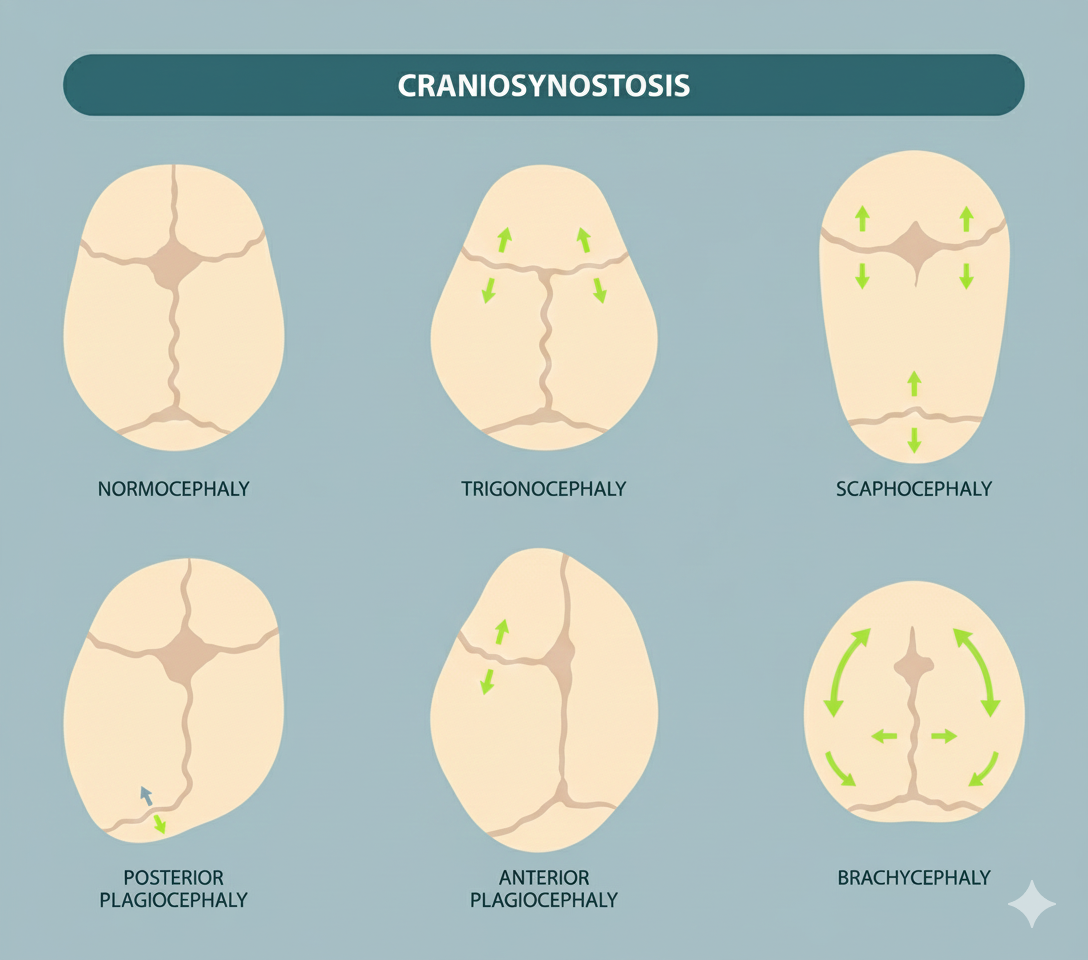
What is craniosynostosis?
A newborn's skull is not one solid bone. It is several bony plates separated by flexible fibrous seams called sutures, with wider soft areas called fontanelles where sutures meet. These seams let the skull compress during birth and then expand as the brain grows quickly through infancy.
Craniosynostosis occurs when one or more of these sutures closes and fuses earlier than expected. The skull cannot easily grow in the direction across a fused seam, so growth is redirected to the sutures that remain open. That redirection is what produces the recognizable head shapes associated with each affected suture.
The condition is generally reported in roughly 1 in 2,000 to 1 in 2,500 births. Most cases involve a single suture and occur without an identified genetic syndrome. A smaller share are syndromic, involving multiple sutures and features elsewhere in the face, hands, or feet, and these are typically managed by a multidisciplinary craniofacial team.
Types of craniosynostosis
Craniosynostosis is usually described by which suture is involved. Each pattern tends to produce a different head shape, although real cases vary and can overlap.
Sagittal suture
ScaphocephalyThe suture running front to back along the midline. Restricted side-to-side growth can leave the head looking long and narrow. This is the most frequently reported single-suture form.
Coronal suture
Anterior plagiocephaly or brachycephalyThe sutures running across the skull from ear to ear. One-sided fusion can flatten one side of the forehead and affect the brow and eye socket on that side; fusion on both sides can leave the head short and wide.
Metopic suture
TrigonocephalyThe suture running down the middle of the forehead. Early fusion can produce a forehead that looks narrow or pointed with a ridge down the midline. A mild forehead ridge alone is common and is not by itself diagnostic.
Lambdoid suture
Posterior plagiocephalyThe sutures across the back of the skull. This is the rarest single-suture form and is the one most often confused with positional flattening, because both affect the back of the head.
Note that some of these names overlap with the vocabulary used for positional conditions. Plagiocephaly and brachycephaly describe head shapes, and those shapes can arise either from outside pressure or from a fused suture. The shared vocabulary is exactly why a clinical evaluation, rather than a label, determines what is going on.
Signs parents may notice
Reported features that lead families to seek evaluation include:
- An unusual head shape that was present at birth or in the first weeks, rather than developing gradually over months.
- A head shape that is becoming more pronounced instead of improving with position changes and growth.
- A firm, raised ridge that can be felt along a seam of the skull.
- A head that looks long and narrow, or short and wide, out of proportion to the rest of the baby.
- A forehead that appears pointed, keel-shaped, or uneven, or a brow and eye socket that look different from one side to the other.
- A soft spot that seems to close unusually early, or concerns about head circumference measurements over time.
None of these observations confirms craniosynostosis. Ridges along sutures can be felt in babies without the condition, mild asymmetry is common, and head shape is influenced by birth, position, and growth. Equally, the absence of an obvious ridge does not rule the condition out. These are reasons to ask a provider, not conclusions.
Craniosynostosis vs. positional flat head
This is the distinction most parents are trying to make, and it is the one that most needs a professional. The comparison below describes tendencies clinicians consider. It is not a checklist for self-assessment, and individual babies do not always follow the pattern.
| Consideration | Positional flattening | Craniosynostosis |
|---|---|---|
| Underlying cause | External pressure on a skull with open sutures | A suture that has fused earlier than expected |
| Typical timing | Often develops or becomes noticeable over the first months | Often noticeable at or soon after birth |
| Course over time | May improve with growth, mobility, and varied positioning | Does not resolve with repositioning; may become more pronounced |
| Suture line | No fused ridge attributable to a closed suture | A firm ridge may be felt along the involved suture |
| Neck movement | Frequently associated with a turning preference or torticollis | Not explained by a positional preference |
| Path of care | Positioning, therapy when indicated, sometimes helmet therapy | Specialist referral; surgical management is common |
Fusion of a lambdoid suture is the form most easily mistaken for positional flattening, since both involve the back of the head. Clinicians look at the overall geometry of the skull from above and behind, the position of the ears relative to one another, the brow and face, and the way the shape has changed over time. Imaging is used when the examination raises concern.
How craniosynostosis is diagnosed
Evaluation starts with history and physical examination. A clinician reviews the pregnancy and birth, when the shape was first noticed, and how it has changed. They examine the head from several views, feel along the suture lines and fontanelles, plot head circumference against growth references, and assess neck movement and development.
When the examination suggests a fused suture, imaging may be used to confirm which sutures are involved and to plan care. Depending on the child's age and the center's practice, this may involve ultrasound of the sutures in young infants, or computed tomography with three-dimensional reconstruction. Referral to a pediatric neurosurgeon or a craniofacial team is typical once the diagnosis is suspected.
Genetic evaluation may be offered when multiple sutures are involved or when other physical features suggest a syndrome.
How craniosynostosis is treated
Treatment is directed by a specialist team and is individualized. Surgery is the mainstay of care for confirmed craniosynostosis, with the goals of allowing room for brain growth and addressing skull shape. Broadly, centers may use minimally invasive endoscopic approaches in younger infants, often followed by a period of post-operative helmet therapy, or open cranial vault remodeling procedures, which are generally performed in older infants. Which approach is appropriate depends on the suture involved, the child's age, the examination, and the center's experience.
Because timing can affect which options are available, families are generally encouraged to raise concerns early rather than waiting to see whether a shape improves on its own.
What head-shape measurements can and cannot tell you
Objective measurements describe the geometry of the head. Cranial Index, or CI, expresses width relative to length. Cranial Vault Asymmetry Index, or CVAI, expresses the difference between two diagonals across the skull. These numbers are useful for documenting proportion and asymmetry, and for tracking whether a shape is changing as a baby grows. The measurement guide explains how they are calculated.
What measurements do not do is assess sutures. A number describes the outside contour of the head; it carries no information about whether a seam has fused. An unusual measurement is a reason to talk with a provider, and a normal-looking measurement does not rule out a suture problem.
SoftSpot® does not detect, diagnose, or rule out craniosynostosis. It is an FDA-cleared measurement tool intended to help measure and track infant head shape so that objective information can be shared with a healthcare provider. Any concern about a baby's skull, sutures, or head growth belongs with a qualified clinician.
When to talk to a healthcare provider
Bring any head-shape question to a well-child visit, where skull shape is part of the routine examination. Contact your provider sooner if the head shape was unusual at or shortly after birth, if it is becoming more pronounced rather than improving, if you feel a firm ridge along a seam, if the soft spot seems to be closing unusually early, or if you have concerns about head growth.
Also raise concerns about feeding, vision, movement, or development alongside the head-shape question, since a clinician interprets these together. Parents do not need to determine the cause before asking. Describing what you have noticed and when you first noticed it is enough.
Frequently asked questions
What is craniosynostosis?
Craniosynostosis is a condition in which one or more of the fibrous joints between the bones of a baby’s skull, called sutures, close earlier than expected. Because the skull cannot grow normally across a fused suture, growth is redirected elsewhere and a characteristic head shape can develop.
How is craniosynostosis different from flat head syndrome?
Positional, or deformational, flattening develops from external pressure on a skull whose sutures are open. Craniosynostosis involves a suture that has fused too early, which is a structural difference in how the skull grows. The two can look similar to a parent but are distinguished by a clinician through examination and, when indicated, imaging.
How common is craniosynostosis?
Craniosynostosis is generally reported to affect roughly 1 in 2,000 to 1 in 2,500 births. Premature fusion of the sagittal suture is the most frequently reported single-suture form. Most cases occur without an identified syndrome.
What are the signs of craniosynostosis in a baby?
Reported features can include an unusual or asymmetrical head shape present early, a firm ridge felt along a suture line, a head that appears long and narrow or short and wide out of proportion, a forehead that looks pointed or uneven, or an anterior fontanelle that closes unusually early. None of these findings confirms the condition on its own.
Can craniosynostosis be treated with a helmet?
A cranial remolding helmet by itself does not treat craniosynostosis, because it does not reopen a fused suture. Helmets are used in positional head-shape conditions and, separately, as part of post-operative care after some endoscopic craniosynostosis procedures. Treatment decisions belong to a craniofacial or neurosurgical team.
Is craniosynostosis surgery always needed?
Management is individualized. Many children with confirmed craniosynostosis are treated surgically, and the approach and timing depend on which suture is involved, the child’s age, growth, examination findings, and whether a syndrome or raised intracranial pressure is present. Only the treating specialist team can determine what is appropriate.
Can a measurement app detect craniosynostosis?
No. Head-shape measurements such as CI and CVAI describe proportion and asymmetry. They do not assess sutures and cannot detect, diagnose, or rule out craniosynostosis. Any unusual head shape should be evaluated by a qualified healthcare provider.
When should I ask a provider about my baby’s head shape?
Raise head-shape questions at well-child visits. Seek timely advice if an unusual shape was present at or soon after birth, if you feel a firm ridge, if the shape is worsening rather than improving, or if you have concerns about head growth, the soft spot, feeding, movement, or development.
Related reading
References
- Dias MS, Samson T, Rizk EB, Governale LS, Richtsmeier JT; AAP Section on Neurologic Surgery and Section on Plastic and Reconstructive Surgery. Identifying the Misshapen Head: Craniosynostosis and Related Disorders. Pediatrics. 2020;146(3):e2020015511. PMID: 32868470.
- Governale LS. Craniosynostosis. Pediatr Neurol. 2015;53(5):394-401. PMID: 26371995.
- Kajdic N, Spazzapan P, Velnar T. Craniosynostosis — recognition, clinical characteristics, and treatment. Bosn J Basic Med Sci. 2018;18(2):110-116. PMID: 28623672.
- Johns Hopkins Medicine. Craniosynostosis.
- American Academy of Pediatrics, HealthyChildren.org. When a Baby's Head Is Misshapen: Positional Skull Deformities.
- U.S. Food and Drug Administration. 510(k) Summary K212045: SoftSpot Cranial Measurement Software.