
Parent newborn-ear guide
Newborn Ear Deformities: A Parent's Guide
Many babies are born with an ear that is folded, cupped, or standing out. Some of these shapes settle on their own; others do not. What makes ear shape unusual among newborn concerns is that the most effective nonsurgical option has a window measured in weeks.
Reviewed by the SoftSpot Clinical & Scientific Team
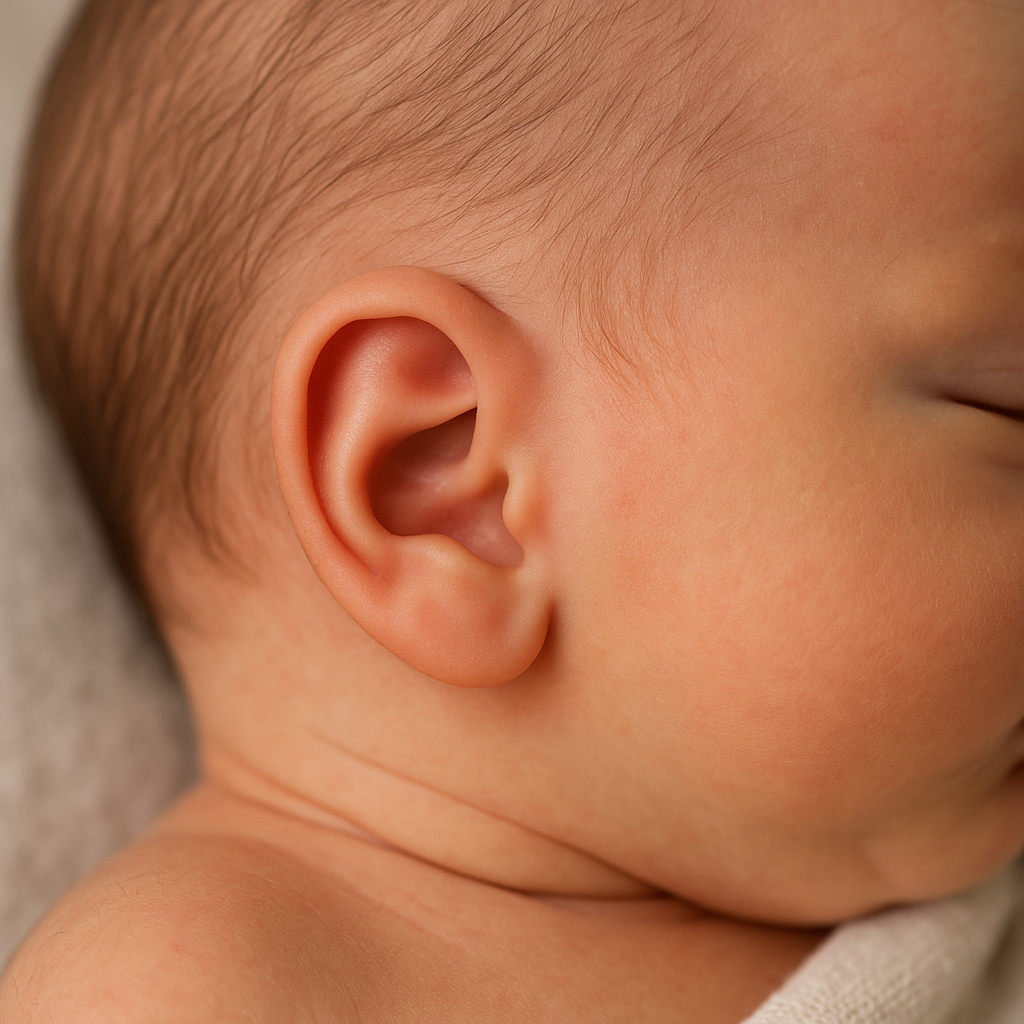
Deformity or malformation?
Clinicians divide unusual newborn ears into two groups, and the distinction determines what can be offered.
Deformity
All of the ear tissue is present, but the shape is distorted — typically by folding or pressure in the womb or around birth. Because the structure exists and only its position is wrong, it may be reshaped nonsurgically while the cartilage is soft.
Malformation
Part of the ear did not develop, as in microtia, where the outer ear is small or incompletely formed. Molding cannot create tissue that is absent, so these are managed differently and often involve a specialist team.
Parents are not expected to make this call. The two can look similar from the outside, and a clinician examining the ear determines which group applies.
Common newborn ear shapes
These descriptions cover shapes frequently discussed in the literature on newborn auricular deformities. Mixed patterns are common, and one ear may differ from the other.
Prominent ear
The ear stands out further from the side of the head than usual, often because a normal fold in the cartilage is shallow or the bowl of the ear is deep.
Lop ear or lidding
The upper rim of the ear folds downward or forward, so the top of the ear looks bent over.
Helical rim deformity
The outer rim of the ear is flattened, compressed, or irregular rather than forming a smooth curve.
Cup ear (constricted ear)
The upper portion appears tight or gathered, and the ear can look smaller, cupped, or pulled forward.
Stahl’s ear
An extra fold of cartilage crosses the upper ear, which can give the rim a pointed or flattened appearance.
Cryptotia
The upper edge of the ear cartilage is tucked beneath the skin of the scalp, so the top of the ear is partly hidden.
Conchal crus
An unexpected fold crosses the bowl of the ear, dividing it and altering the normal contour.
An ear that is temporarily folded from the way a baby has been lying is also common and often settles quickly. Persistence is the useful signal: a shape that is still present after the first days deserves a conversation.
Do newborn ear shapes correct themselves?
Sometimes. Studies of newborn ears report that a meaningful share of deformities improve without any treatment during the early weeks, while others persist unchanged. Reported rates vary considerably between studies depending on how ears were classified and how long infants were followed.
The practical problem is that no one can tell at day three which group a particular ear belongs to. Because the nonsurgical window is short, clinicians who treat these conditions generally prefer to see the baby early and then decide, rather than observe for several weeks and discover the option has narrowed.
Why the first weeks matter
Newborn ear cartilage is unusually soft, and it does not stay that way. This malleability is attributed largely to maternal hormones still circulating in the infant after birth, which increase the water-binding properties of cartilage. Those levels decline over roughly the first six weeks.
As a result, protocols for nonsurgical molding generally favor starting in the first weeks of life. Treatment begun later may still be attempted, but often requires a longer course and produces less predictable results.
This is the single most useful thing for a parent to know about ear shape, and it differs sharply from head shape. With positional head flattening, watchful waiting with repositioning is a reasonable early step. With ear deformities, waiting can close the door on the least invasive option.
What ear molding involves
Ear molding uses a device that holds the cartilage in a corrected shape continuously for a period of weeks. A clinician assesses the ear, applies and shapes the device, and reviews the ear at intervals to check the skin and adjust as needed. It does not involve cutting or anesthesia, and it is generally described as nonpainful for the infant.
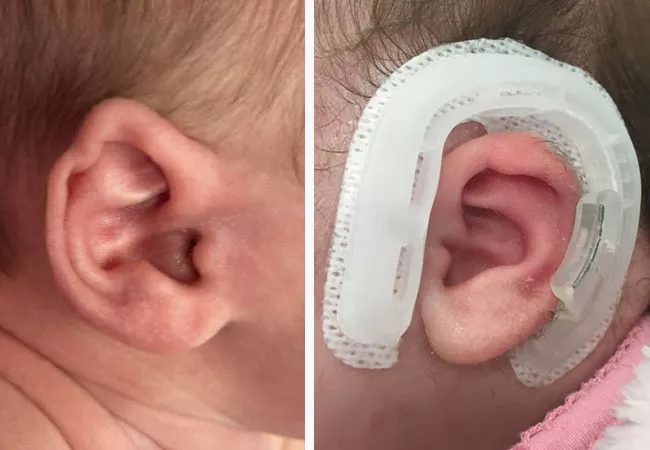
Typical courses are described in weeks rather than months, with duration depending on the shape being treated and the age at which treatment started. Skin irritation where the device contacts the ear is the issue most often discussed, and it is a reason the treating clinician monitors the course rather than the family managing it alone.
Availability differs by region. Not every pediatric practice offers molding, and families are often referred to a plastic surgery, craniofacial, or ENT service that does.
If the molding window has passed
Missing the early window does not mean nothing can be done. It means the conversation shifts. Surgical reshaping of the outer ear, called otoplasty, is generally discussed later in childhood, once the ear has grown close to adult size. Families often weigh this around school age, when a child may begin to notice or comment on ear appearance.
Candidacy, timing, and expected results are decisions for a specialist and family together. An ear that stands out is a cosmetic and psychosocial consideration rather than a medical emergency, and there is no single right answer about whether or when to pursue surgery.
Ear shape, hearing, and related findings
The shape of the outer ear does not by itself determine hearing. A baby can have a noticeably folded or prominent ear and entirely normal hearing. However, some conditions that affect how the ear develops can also involve the ear canal or middle ear, so the outer ear is one part of a broader assessment rather than the whole picture.
Newborn hearing screening applies to every baby regardless of ear shape, and any follow-up testing your provider recommends should be completed. Small skin tags or pits in front of the ear are also sometimes noted at birth; mention them to your provider, who can advise whether anything further is warranted.
Ear position and head shape
Ear shape and ear position are different observations. Parents who notice that one ear sits further forward or lower than the other are often describing something about the skull rather than the ear itself: in positional head flattening, the ear on the affected side can appear shifted relative to the other.
If what you are noticing is asymmetry between the two sides rather than the contour of one ear, the plagiocephaly guide may be the better starting point, and craniosynostosis covers the less common structural causes of an unusual head shape.
When to talk to a healthcare provider
Raise ear shape at the first newborn visit if you have noticed anything. Specifically, mention an ear that is folded at the top, looks cupped or tight, has a pointed or flattened rim, stands out noticeably, has part of its upper edge tucked under the scalp, or looks small or incompletely formed. Say when you first noticed it and whether it has changed.
Ask directly whether nonsurgical molding is worth considering and, if so, where it is offered locally. Because availability varies and the window is short, an early referral question is more useful than a later one.
Frequently asked questions
What is the difference between an ear deformity and an ear malformation?
A deformity is an ear that formed completely but has an abnormal shape, usually from external folding or pressure before or around birth. A malformation involves tissue that did not develop fully, such as microtia. Deformities are the group that may respond to nonsurgical molding; missing tissue cannot be molded into existence and is managed differently.
Will my newborn’s ear shape correct itself?
Some newborn ear shapes do improve on their own during the first weeks, and studies report a meaningful proportion resolving without treatment. Others persist. Because the window in which nonsurgical molding works best is short, an ear shape that concerns you is worth raising with a provider early rather than waiting to see.
What is infant ear molding?
Ear molding is a nonsurgical approach in which a device holds the ear cartilage in a corrected position for a period of weeks while the cartilage is still highly malleable. It is applied and monitored by a trained clinician. It is used for deformities of an otherwise fully formed ear.
When should ear molding start?
Earlier is generally better. Cartilage malleability in newborns is attributed largely to circulating maternal hormones, which decline over roughly the first six weeks of life. Many protocols favor starting within the first weeks after birth. Treatment may still be attempted later, often with a longer course and less predictable results.
Is ear molding painful for a baby?
Ear molding is generally described as nonpainful and does not involve cutting or anesthesia. Skin irritation at the device site is the most commonly discussed issue, which is one reason treatment is monitored by the clinician who applied it.
Do prominent or misshapen ears affect hearing?
An abnormally shaped outer ear does not by itself mean hearing is affected. Some conditions involving underdeveloped ear structures can involve the ear canal or middle ear and may affect hearing. Newborn hearing screening and any follow-up recommended by your provider remain important regardless of outer ear shape.
What happens if the molding window is missed?
If nonsurgical molding is no longer an option or was not effective, surgical reshaping, called otoplasty, may be discussed later in childhood, typically once the ear is closer to adult size. Timing and candidacy are decisions for the treating specialist and family.
Can an app diagnose an ear deformity?
No. Photo-based tools can help parents document and describe what they are seeing, but they do not diagnose ear deformities or malformations, assess the ear canal, or determine treatment. A qualified clinician should evaluate any concern about ear shape.
Related reading
References
- Matsuo K, Hirose T, Tomono T, et al. Nonsurgical correction of congenital auricular deformities in the early neonate: a preliminary report. Plast Reconstr Surg. 1984;73(1):38-51. PMID: 6691074.
- Byrd HS, Langevin CJ, Ghidoni LA. Ear molding in newborn infants with auricular deformities. Plast Reconstr Surg. 2010;126(4):1191-1200. PMID: 20453717.
- van Wijk MP, Breugem CC, Kon M. Non-surgical correction of congenital deformities of the auricle: a systematic review of the literature. J Plast Reconstr Aesthet Surg. 2009;62(6):727-736. PMID: 19328756.
- van Wijk MP, Breugem CC, Kon M. A prospective study on non-surgical correction of protruding ears: the importance of early treatment. J Plast Reconstr Aesthet Surg. 2012;65(1):54-60. PMID: 21903493.
- Daniali LN, Rezzadeh K, Shell C, Trovato M, Ha R, Byrd HS. Classification of Newborn Ear Malformations and Their Treatment with the EarWell Infant Ear Correction System. Plast Reconstr Surg. 2017;139(3):681-691. PMID: 28234847.
- Children's Hospital of Philadelphia. Ear Deformities.
- Boston Children's Hospital. Ear Molding.