
Parent guide
Is My Baby's Head Shape Normal? Signs of a Flat Head & What Parents Should Know
Baby head shape can be difficult to judge by sight alone. This guide explains common positional changes, what parents can observe, how objective measurements work, and when to discuss concerns with a healthcare provider.
Reviewed by the SoftSpot Clinical & Scientific Team
What is a normal baby head shape?
There is no single head shape that every healthy baby must match. Newborn heads can look slightly uneven, elongated, or molded after pregnancy and delivery. The skull is made of flexible bony plates with spaces between them, allowing the head to pass through the birth canal and leaving room for rapid brain growth. Birth-related molding often becomes less noticeable during the early weeks.
Parents may expect a perfectly round head, but small differences between the right and left sides can be difficult to interpret without context. What matters is the complete pattern: how the head looks from above, behind, and from each side; whether the shape is changing; how the head is growing; and whether the baby moves the neck comfortably in both directions. These are all things a pediatrician can review during routine visits.
What does a baby's head shape look like from above?
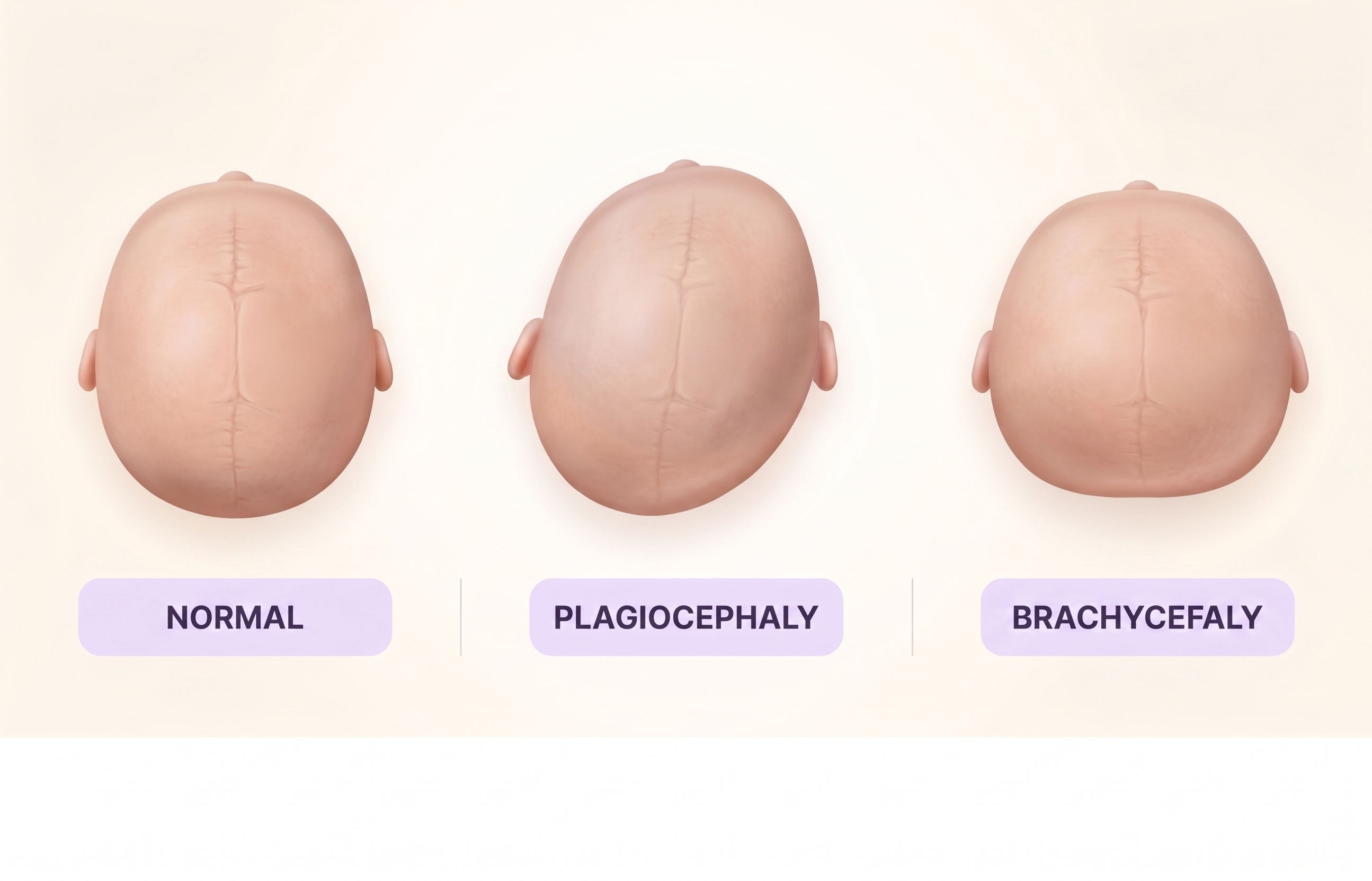
A top view can make broad shape patterns easier to notice. The examples below are simplified educational references, not diagnostic standards; real infant head shapes vary, and a healthcare provider should interpret any concern.
Normal
Generally rounded and balanced, with natural variation.
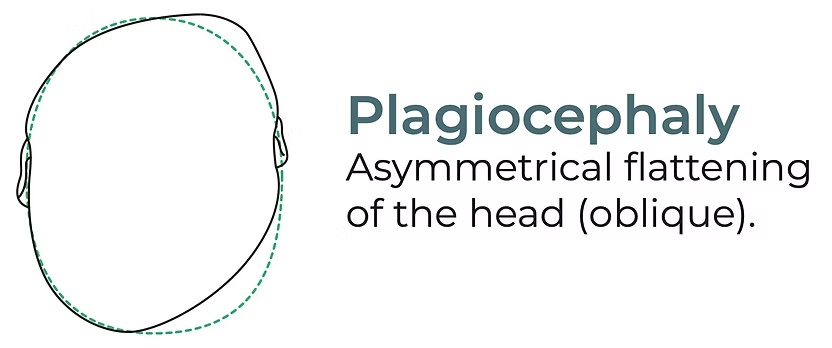
Plagiocephaly
Flattening appears greater on one side.
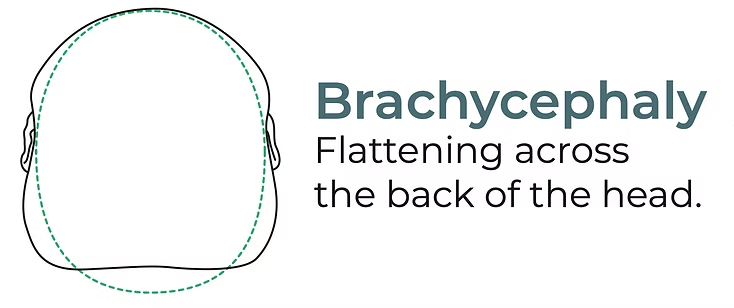
Brachycephaly
Flattening appears broader across the back.
Why can a baby's head become flat?
Because an infant's skull is flexible, repeated pressure on the same area can influence its shape. A baby may prefer turning toward one side, spend extended time with the head against a firm surface, have limited neck movement, or have less opportunity to change position. Premature babies may be more vulnerable because their skull bones are softer and they may spend more time positioned in medical care. Crowding in the womb, multiple births such as twins, and the delivery process can also affect early head shape. Feeding and reflux patterns can contribute as well, when a baby is consistently more settled facing one direction.
Torticollis, which involves tightness or imbalance in the neck muscles, may make it hard for a baby to turn evenly and can occur alongside positional flattening. Learn more in the existing torticollis resource. A persistent head-turning preference is worth mentioning to your baby's provider.
Babies should still be placed on their backs for every sleep. Do not change a baby's sleep position because of head-shape concerns unless a qualified clinician gives you individualized instructions. Position changes and supervised tummy time are for awake periods. The American Academy of Pediatrics emphasizes “back to sleep” and supervised “tummy to play.”
What does a flat head look like?
A flat spot can be subtle, especially under thick hair. It may be easier to notice after a bath, when the hair is wet, or by looking down from above while another adult safely holds the baby. The goal is not to label the shape at home. It is to notice whether a pattern is present and decide whether to bring that observation to a provider.
Flat on one side: plagiocephaly
Positional plagiocephaly describes asymmetrical flattening, usually at the back on one side. From above, one side may look flatter, and the ear or forehead on that side may appear shifted. Similar-looking patterns can have different causes, so visual appearance alone is not enough to diagnose plagiocephaly.
Flat across the back: brachycephaly
Positional brachycephaly describes more even flattening across the back. The head may look wider from side to side and shorter from front to back. A provider considers the full shape and examination rather than deciding from width alone.
How parents can check their baby's head shape
Choose a calm, awake moment and use this simple checklist to organize what you notice:
- From above: Compare the curves on both sides. Notice whether one side of the back looks flatter, the whole back looks broad and flat, or the ears and forehead appear uneven.
- From behind: Look for a broad flat area across the back or one side that appears flatter than the other.
- Preferred head-turning direction: Notice whether your baby repeatedly rests or looks toward the same side during awake time.
- Neck movement: Watch whether your baby turns comfortably both ways or seems to have difficulty turning toward one side.
- Hair wear: Notice whether hair looks thinner or more rubbed on one particular area of the head, which can indicate where pressure is repeatedly concentrated.
If you take progress photos, use the same general angle and lighting and compare changes over weeks rather than repeatedly checking during one day. Bring observations or photos to a routine visit instead of trying to diagnose the shape at home.
A positional flat spot is different from craniosynostosis, in which one or more skull sutures close earlier than expected. Parents cannot reliably make that distinction from a photograph. A healthcare provider can examine the sutures, growth pattern, facial features, and head movement and decide whether any additional evaluation is appropriate.
Visual observation vs. objective measurement
Looking at your baby's head can help you notice possible asymmetry, but human perception changes with viewing angle, hair, lighting, and memory. A photo can make a shape look different when the camera is tilted or the baby turns. Objective measurement uses a repeatable method to describe dimensions numerically, making it easier to compare one point in time with another.
Measurement still does not equal diagnosis. A number does not explain why a shape looks different, rule out another condition, or determine whether treatment is needed. It is one piece of information that can be considered alongside physical examination, age, growth, neck movement, medical history, and a clinician's judgment.
How infant head shape is measured
Clinicians may assess head shape by examining the baby from several views, measuring head circumference, and using calipers, photographs, or other validated measurement systems. Two measurements parents may see in a head-shape report are Cranial Index and Cranial Vault Asymmetry Index. Both are explained in full, with how they are calculated and what the reference ranges describe, in our guide to how baby head shape is measured.
Cranial Index (CI)
CI describes overall head width relative to length.
Cranial Vault Asymmetry Index (CVAI)
CVAI describes asymmetry between the two sides of the head.
Looking at your baby's head can help you notice possible asymmetry, but visual observation is different from objective measurement. SoftSpot® is an FDA-cleared measurement tool designed to measure and track infant head shape using measurements including CI and CVAI. Its FDA-cleared indication is cranial measurement for infants from 1 month up to 2 years of age in conjunction with other clinical methods. It does not diagnose plagiocephaly or determine whether treatment is required.
If you already have a SoftSpot report, the existing How to Read Your SoftSpot® Report guide explains its measurement layout. For capture instructions, visit Getting Started with SoftSpot®.
Will my baby's flat head round out?
This is usually the first question parents ask, and the honest answer is that it depends. Many positional head-shape differences do become less noticeable as babies grow, gain head control, start moving more, and spend less awake time resting on the same area. Others persist, and a smaller number become more pronounced.
What no one can do is predict the course from a single look. Appearance at one moment does not establish the cause, the severity, or what will happen over the next few months. That is why the useful question is not will it round out but is it changing, and in which direction. Our guides to plagiocephaly and brachycephaly cover how each pattern tends to behave.
If you want practical steps rather than watchful waiting, our guide to helping a flat head without a helmet walks through supervised tummy time, awake repositioning, and when a physical therapy evaluation may be worth discussing.
Does my baby's age matter?
Yes, though not as a set of fixed deadlines. An infant skull is most malleable and growing fastest in the early months, so the same observation can carry different weight at different ages. The table below describes what tends to be emphasized when, not rules about what must happen by a certain date.
| Stage | What is usually emphasized |
|---|---|
| Newborn weeks | Safe sleep for every sleep, starting supervised awake tummy time, and noticing whether your baby turns comfortably both ways. |
| Early months | The period when positional flattening is most often first noticed, and when varied awake positioning and evaluation of a turning preference are commonly discussed. |
| Around and after the middle of the first year | Babies become more mobile and spend less time resting on one area. If a shape has not changed, providers may discuss further evaluation. |
| Later infancy | Skull growth slows. Options that depend on rapid growth become less applicable, which is why unresolved concerns are worth raising rather than deferring. |
One study is often cited here. In a retrospective review of more than 25,000 children with positional plagiocephaly, diagnosis after 6 months was associated with being 2.63 times as likely to be referred for helmet evaluation and 1.64 times as likely to require helmet therapy, compared with diagnosis by 6 months. This is an association from an observational study; it does not show that earlier detection prevents helmet therapy. What it reasonably supports is raising concerns at routine visits rather than waiting alone. See our guide to how helmet decisions are made for how age factors into that conversation.
When should parents discuss head-shape concerns with a provider?
You can ask about head shape at any well-child visit, and you do not need to wait until you are certain something is wrong. Contact your pediatrician or qualified healthcare provider if you notice a flat area that persists or becomes more noticeable, a strong preference for looking in one direction, a consistent head tilt, limited neck movement, or an unusual change in head shape or growth. A provider can determine whether the appearance is positional and whether observation, measurement, referral, or another step is appropriate.
AAP Bright Futures guidance includes assessment for positional skull deformities as part of routine infant health supervision. Parents should mention persistent flattening or asymmetry so their pediatrician can evaluate it in the context of the complete examination.
A retrospective study of more than 25,000 children with positional plagiocephaly found that diagnosis after 6 months was associated with higher rates of helmet evaluation and helmet therapy than diagnosis by 6 months. The study does not prove that early recognition prevents helmet use, but it supports raising persistent concerns early so head shape can be evaluated, objectively monitored when appropriate, and discussed with your pediatrician.
Do not use head-shaping pillows or change safe-sleep practices in an attempt to alter head shape. Continue placing your baby on their back for sleep on a firm, flat sleep surface. Tummy time should happen only while the baby is awake and directly supervised.
Does noticing a flat spot mean helmet therapy is needed?
No. A visible flat spot or a measurement does not automatically lead to helmet therapy. Many factors influence clinical recommendations, including the cause and pattern of the shape, the baby's age and growth, neck movement, severity, and change over time. Some babies are monitored or receive positioning and physical-therapy guidance; a qualified provider may discuss a cranial orthosis for selected cases. Only the baby's care team can recommend an appropriate plan after evaluation.
Frequently asked questions
Is a flat spot on a baby's head normal?
Slight unevenness is common in newborns, especially after birth, and a positional flat spot can develop during the first months. A visible flat area should still be mentioned at a well-child visit so a healthcare provider can examine the full head shape and growth pattern.
How can I tell if my baby has a flat head?
Look from above and behind when your baby is calm. Notice whether one side of the back looks flatter, the whole back looks broad and flat, the ears seem uneven, or your baby repeatedly turns toward one side. These observations can identify a question to raise, but they cannot confirm a condition.
At what age should I be concerned about a flat head?
You do not need to wait for a particular age to ask. Head shape changes often become noticeable in the first few months, and routine well-child visits are a good time to discuss them. Contact your baby's provider sooner if the shape is changing quickly or you notice a persistent head tilt or limited neck movement.
Can a baby's flat head improve as they grow?
Some positional flattening improves as babies gain head control, become more mobile, and spend less time resting on the same area. Progress varies, so repeated observation or measurement can be more useful than relying on memory. A provider can advise what follow-up is appropriate for your baby.
What is the difference between plagiocephaly and brachycephaly?
Positional plagiocephaly generally describes flattening that is greater on one side of the back of the head. Brachycephaly generally describes more even flattening across the back, which can make the head appear wider. A healthcare professional should evaluate the complete shape rather than a single feature.
How is a baby's head shape measured?
Providers may use physical examination, head circumference, calipers, photography, or other validated methods. Cranial Index describes the relationship between head width and length. Cranial Vault Asymmetry Index compares diagonal dimensions to describe asymmetry. Measurements support clinical assessment; they are not a diagnosis by themselves.
Does a flat head always mean a baby needs a helmet?
No. A flat appearance does not by itself determine treatment. A provider considers the cause, age, growth, severity, neck movement, response over time, and other clinical findings. Helmet therapy is one possible option for selected babies, not an automatic result of noticing a flat spot.
A practical next step
If you are wondering whether your baby's head shape is normal, write down what you notice, take consistent photos if helpful, and discuss the pattern at a pediatric visit. Objective measurements can make change easier to document, but they should remain part of a broader clinical conversation. You can also explore the parent resources on tummy time, torticollis, positioning, and professional support.
References
- American Academy of Pediatrics, HealthyChildren.org. When a Baby's Head Is Misshapen: Positional Skull Deformities.
- Mayo Clinic. Baby's Head Shape: Cause for Concern?.
- Johns Hopkins Medicine. Deformational Plagiocephaly.
- U.S. Food and Drug Administration. SoftSpot 510(k) Premarket Notification K212045.
- Munabi CO, Nelson MS, Francis SH. Risk Factors for Delayed Diagnosis of Positional Plagiocephaly: A Review of 25,322 Patients. Cleft Palate Craniofac J. 2024;61(10):1679-1686. PMID: 37248557.
- Hagan JF Jr, Shaw JS, Duncan PM, eds. Bright Futures: Guidelines for Health Supervision of Infants, Children, and Adolescents. 4th ed. American Academy of Pediatrics. 2017.