
Parent head-shape guide
Plagiocephaly in Babies: A Parent's Guide
Plagiocephaly is a pattern of baby head asymmetry, most often noticed as a flat area on one side of the back of the head. This guide explains what parents may observe, why positional flattening can develop, and how healthcare providers assess it.
Reviewed by the SoftSpot Clinical & Scientific Team
What is plagiocephaly?
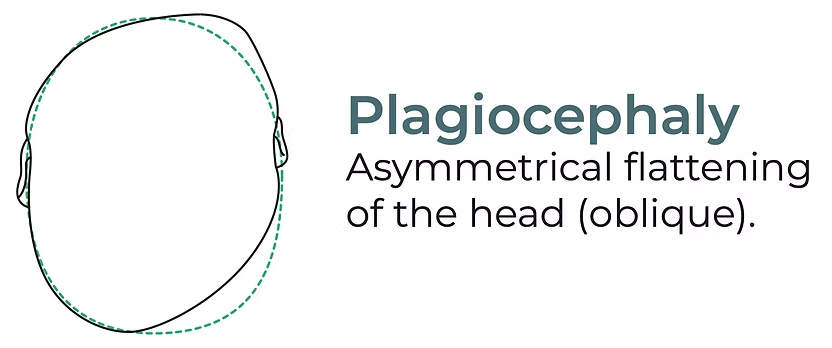
Plagiocephaly describes an asymmetrical head shape. In positional plagiocephaly, also called deformational plagiocephaly, one side of the back of a baby's flexible skull becomes flatter because that area has experienced more external pressure. Parents sometimes use the broader phrase flat head syndrome, but that phrase can refer to more than one shape pattern.
Plagiocephaly differs from brachycephaly. With plagiocephaly, flattening is greater on one side. Brachycephaly generally involves more even flattening across the back, so the head may appear proportionally wide and short. A baby can have features of both. For a broader visual overview, see Is My Baby's Head Shape Normal?
What does plagiocephaly look like?
A top view is often the clearest way to notice a baby flat head on one side. The back of the head may look rounded on one side and flatter on the other. Depending on the pattern, the ear on the flatter side may appear shifted and one side of the forehead may look more prominent. Hair can also look thinner or more worn over the area bearing repeated pressure, which some parents notice before the shape itself. These associated features are not the same in every baby. A shifted ear position is a different observation from the shape of the ear itself, which is covered in our guide to newborn ear deformities.
Photos and casual observation are sensitive to camera angle, hair, lighting, and the way the baby is positioned. A healthcare professional considers the complete head shape, facial features, sutures, growth, and neck movement rather than diagnosing from one view.
What causes positional plagiocephaly?
A young infant's skull is naturally flexible. Positional plagiocephaly can develop when one area repeatedly bears more pressure during a period of rapid growth. This may occur when a baby regularly rests with the head turned the same way or spends long awake periods in one position.
Other well-supported plagiocephaly causes and contributing factors include a head-turning preference or limited neck motion, prematurity, twins or another multiple birth, limited space in the uterus, and positioning related to birth. Premature babies may have more flexible skulls and may spend additional time lying in medically necessary positions. Feeding and reflux patterns can contribute too, when a baby is consistently more settled facing one direction. These factors do not mean that a parent caused the head shape.
Plagiocephaly and torticollis
Torticollis involves a neck-muscle imbalance that can make a baby tilt the head or prefer looking in one direction. A persistent preference can keep pressure on the same part of the skull, contributing to positional plagiocephaly. Head asymmetry can also reinforce a preferred resting position, so the two concerns may appear together.
Tell your baby's provider if turning looks easier in one direction, the head is regularly tilted, or neck movement seems limited. The provider may recommend an evaluation and, when appropriate, pediatric physical therapy or individualized exercises. Learn more in the existing torticollis resource.
How is plagiocephaly measured?
Visual examination helps identify a possible pattern, while objective measurements quantify cranial asymmetry. Clinicians may compare two diagonal dimensions across the head. Cranial Vault Asymmetry Index, or CVAI, describes the difference between those sides relative to head size. Measurements may be obtained with methods such as calipers, standardized imaging, or validated digital tools.
A measurement cannot establish cause, rule out another condition, or determine care by itself. Technique and classification systems also vary. For the full parent-friendly explanation of dimensions, CI, CVA, and CVAI, use the dedicated guide.
Learn how baby head shape is measuredMild, moderate and severe plagiocephaly
Clinicians and researchers may use terms such as mild, moderate, or severe to communicate the amount of asymmetry. Some classification systems use CVA or CVAI ranges, but thresholds, measurement angles, and category names are not universal. A result should be interpreted using the reference system associated with the measurement method.
Plagiocephaly severity cannot be determined reliably by a parent's visual estimate or by one number in isolation. Age, growth, neck motion, facial features, clinical examination, cause, and change over time can all matter. To review the site's existing interpretation guidance without duplicating its tables, visit Understanding Your SoftSpot® Report.
Does plagiocephaly improve?
Some positional asymmetry improves as a baby grows, gains head control, becomes more mobile, and spends less awake time resting on the same part of the head. The amount and pace of change vary. Improvement should not be promised based on appearance, age, or a single measurement.
Healthcare providers commonly emphasize varied positioning during awake time and regular, supervised tummy time. Holding, feeding from alternating sides, and changing the direction a baby looks toward caregivers or interesting objects may reduce repeated awake pressure, provided these changes are safe and appropriate for the child. Avoid long periods in car seats, swings, or carriers when they are not needed for travel or care.
Our step-by-step guide to helping a flat head without a helmet covers these approaches in more detail. If torticollis or restricted neck movement is present, addressing it with provider-directed care or physical therapy may help a baby turn both ways more comfortably. Follow-up lets the provider assess growth, movement, and head-shape change together and decide whether additional evaluation is appropriate.
Why Routine Head-Shape Checks Matter
The American Academy of Pediatrics' Bright Futures guidance includes a complete physical examination as part of infant health-supervision visits and directs clinicians to assess or observe for positional skull deformities. This supports looking at head and skull shape as part of routine well-child care; Bright Futures does not specifically require CI or CVAI measurement.
Visual examination is important for identifying obvious flattening or asymmetry, but it does not provide a numerical measure of head proportion or side-to-side difference. Subtle changes can also be difficult to compare over time by sight alone. Objective measurement, when appropriate and available, can complement—not replace—the history and clinical examination.
Why early recognition matters
In a retrospective study of 25,322 children with positional plagiocephaly, diagnosis after 6 months was associated with being 2.63 times as likely to be referred for helmet evaluation and 1.64 times as likely to require helmet therapy compared with diagnosis by 6 months. This observational association does not prove that early recognition prevents helmet therapy, but it supports timely evaluation and follow-up. Learn more about how helmet decisions are made.
Routine observation → objective measurement when appropriate → tracking over time → informed discussion with the healthcare provider.
SoftSpot® was developed to provide an accessible, objective way to measure and track infant head shape using measurements such as CI and CVAI, complementing—not replacing—the clinical examination. SoftSpot does not diagnose plagiocephaly or determine treatment.
Does plagiocephaly mean my baby needs a helmet?
No. Having plagiocephaly does not automatically mean a baby needs helmet therapy. Plagiocephaly treatment decisions are individualized and may consider the child's age, growth, clinical examination, cause, measured asymmetry, changes over time, neck movement, and response to conservative approaches.
Measurements alone should never be used to decide that a helmet is needed. A pediatrician or other qualified healthcare professional can explain appropriate options and, when necessary, refer the family to a specialist.
When should parents talk to a healthcare provider?
Bring up any head-shape concern at a well-child visit. Contact the provider if flattening persists, appears to progress, or is accompanied by a strong turning preference, head tilt, or difficulty turning both ways. Seek timely advice if you notice an unusual ridge, an atypical shape that was present early, or any concern about head growth, feeding, movement, or development.
Positional plagiocephaly is different from craniosynostosis, in which a skull suture closes too early and affects skull growth. Parents cannot reliably distinguish every unusual shape at home. A trained professional can examine the sutures and head from multiple views, review the growth pattern and history, assess neck movement, and decide whether observation, therapy, imaging, or specialty referral is appropriate.
Tracking head shape over time
Visual observation is useful for noticing a possible flat area, but memories and photographs taken from different angles can make comparison difficult. Objective measurements create a consistent numerical record of overall proportion and side-to-side asymmetry. When captured with the same validated method, measurements can help document whether head shape is changing as the baby grows.
Tracking is information gathering, not diagnosis. Trends should be shared with the child's healthcare provider, who can interpret them alongside age, examination findings, growth, neck movement, and medical history.
Frequently asked questions
What is plagiocephaly?
Plagiocephaly is an asymmetrical head shape in which one side of the back of a baby’s head is flatter than the other. Positional, or deformational, plagiocephaly develops from external pressure rather than the early fusion of a skull suture.
What causes plagiocephaly in babies?
Factors can include spending substantial time with the head resting in one position, a preferred head-turning direction or torticollis, prematurity, limited space before birth, and positioning related to birth. A healthcare provider can consider the full history and examination.
How can I tell if my baby has plagiocephaly?
From above, parents may notice flattening on one side at the back, with possible differences in ear or forehead position. Appearance alone cannot confirm the cause, diagnosis, or severity, so discuss a persistent or unusual shape with a healthcare provider.
Is plagiocephaly the same as flat head syndrome?
Flat head syndrome is an informal phrase that may refer to positional plagiocephaly or other flattened head shapes. Plagiocephaly more specifically describes asymmetry, usually with one side of the back flatter than the other.
What is the difference between plagiocephaly and brachycephaly?
Plagiocephaly describes greater flattening on one side and an asymmetrical shape. Brachycephaly generally describes broader flattening across the back, making the head proportionally wider and shorter. The patterns can occur together.
Can plagiocephaly improve as a baby grows?
Some positional head-shape asymmetry improves as babies grow, move more, and spend less awake time resting on the same area. Progress differs among babies. Supervised tummy time, varied awake positioning, and treatment of torticollis when prescribed may be helpful.
How is plagiocephaly measured?
A clinician may assess the head from several views and use diagonal measurements to quantify cranial asymmetry. Cranial Vault Asymmetry Index, or CVAI, is one commonly used measurement. Numbers support, but do not replace, a clinical evaluation.
Does plagiocephaly always require a helmet?
No. Plagiocephaly does not automatically mean a baby needs helmet therapy. Decisions depend on age, growth, examination findings, cause, measured changes over time, response to conservative care, and other clinical factors.
When should I be concerned about my baby's head shape?
Talk with your baby’s healthcare provider if flattening persists or progresses, your baby strongly prefers one direction or has limited neck movement, you feel an unusual ridge, or the shape seems unusual. A professional can distinguish positional flattening from other causes.
References
- American Academy of Pediatrics, HealthyChildren.org. When a Baby's Head Is Misshapen: Positional Skull Deformities.
- Johns Hopkins Medicine. Deformational Plagiocephaly.
- Linz C, et al. Positional Skull Deformities: Etiology, Prevention, Diagnosis, and Treatment. Deutsches Ärzteblatt International. 2017.
- van Vlimmeren LA, et al. Methods to Diagnose, Classify, and Monitor Infantile Deformational Plagiocephaly and Brachycephaly: A Narrative Review. Journal of Chiropractic Medicine. 2015.
- Hagan JF Jr, Shaw JS, Duncan PM, eds. Bright Futures: Guidelines for Health Supervision of Infants, Children, and Adolescents. 4th ed. American Academy of Pediatrics. 2017.
- Feijen MMW, Schuckman M, Habets E, van der Hulst RRWJ. Positional plagiocephaly and brachycephaly: is there a correlation between subjective and objective assessment of cranial shape? J Craniofac Surg. 2012;23(4):998-1001. PMID: 22777451.
- Munabi CO, Nelson MS, Francis SH. Risk Factors for Delayed Diagnosis of Positional Plagiocephaly: A Review of 25,322 Patients. Cleft Palate Craniofac J. 2024;61(10):1679-1686. PMID: 37248557.
- U.S. Food and Drug Administration. 510(k) Summary K212045: SoftSpot Cranial Measurement Software.