
Parent product guide
Perfect Noggin, Mimos & Tortle: What Parents Should Know About Flat Head Products
Search for help with a baby's flat head and these three names come up quickly. They are not three versions of the same thing. They differ in what they physically are, in what regulators have and have not reviewed, and in how much published evidence exists behind them.
Reviewed by the SoftSpot Clinical & Scientific Team
Sleep surface
Replaces the mattress
Pillow
Added under the head
Worn on the head
Nothing added to the surface
Start with an important distinction
These three products are often listed together in search results and parent forums, which makes them look like competing versions of one idea. They are not equivalent, and the differences matter more than the similarities.
- Perfect Noggin is a sleep surface. It replaces the mattress your baby lies on, so infant safe-sleep requirements apply to it directly.
- Mimos is a pillow. It is an object added beneath the head, which is the specific product category the FDA has issued a safety communication about.
- Tortle is worn on the head. It adds nothing to the sleep surface, which places it in a different safety conversation from the other two.
They also differ sharply in regulatory history. One of the three has an FDA 510(k) clearance on file. The other two did not return records in the FDA databases we searched. And a clearance, as explained below, is not a finding that a product works.
Side-by-side comparison
| Product | Type | Intended approach | When / how used | Regulatory status | Evidence | Key safety considerations |
|---|---|---|---|---|---|---|
| Perfect Noggin | Contoured infant sleep surface (mattress) | Manufacturer describes a concave head recess intended to redistribute pressure away from flat areas | Manufacturer describes use for infants roughly 2–6 months, as the sleep surface | No 510(k) clearance and no device listing record found in FDA databases | No peer-reviewed clinical studies identified in PubMed | It is the sleep surface itself, so AAP and CPSC firm, flat, level, non-inclined guidance applies directly |
| Mimos Pillow | Infant head-shaping pillow | Manufacturer describes a breathable 3D structure intended to distribute pressure across a wider area | Manufacturer describes use beneath the head while lying down | No FDA 510(k) or listing record found. Manufacturer states EU Class I CE marking under MDR 2017/745 | No peer-reviewed clinical studies of the pillow identified in PubMed | FDA advises against infant head-shaping pillows; AAP advises no pillows in the infant sleep space |
| Tortle | Repositioning beanie worn on the head | A small roll on the beanie is intended to encourage the head to turn toward a chosen side | Worn on the head; nothing loose is added to the sleep surface | FDA 510(k) K082367, "Infant Sleep Beanie," Substantially Equivalent, June 12, 2009 (clearance, not approval) | Two small non-randomized studies in preterm infants; no randomized trial in term infants identified | Nothing added to the sleep surface, but fit, supervision and skin checks still matter; discuss with your provider |
“No record found” means a search of the named FDA databases on September 2, 2026 using the product and company names did not return a matching entry. It is a description of what those public databases contained on that date, not a statement about product quality or safety.
“FDA registered” is not “FDA approved”
Marketing tends to blur these, and parents reasonably read all of them as “a regulator checked this.” Three terms come up around the products on this page, and they mean very different things.
A European CE mark is a separate system. For the lowest-risk class it is self-certified by the manufacturer with no outside review of clinical evidence, and it carries no status in the United States.
Perfect Noggin
What it is. Perfect Noggin is a contoured infant mattress. Rather than sitting on top of a sleep surface, it is the sleep surface, with a shaped recess where the head rests.
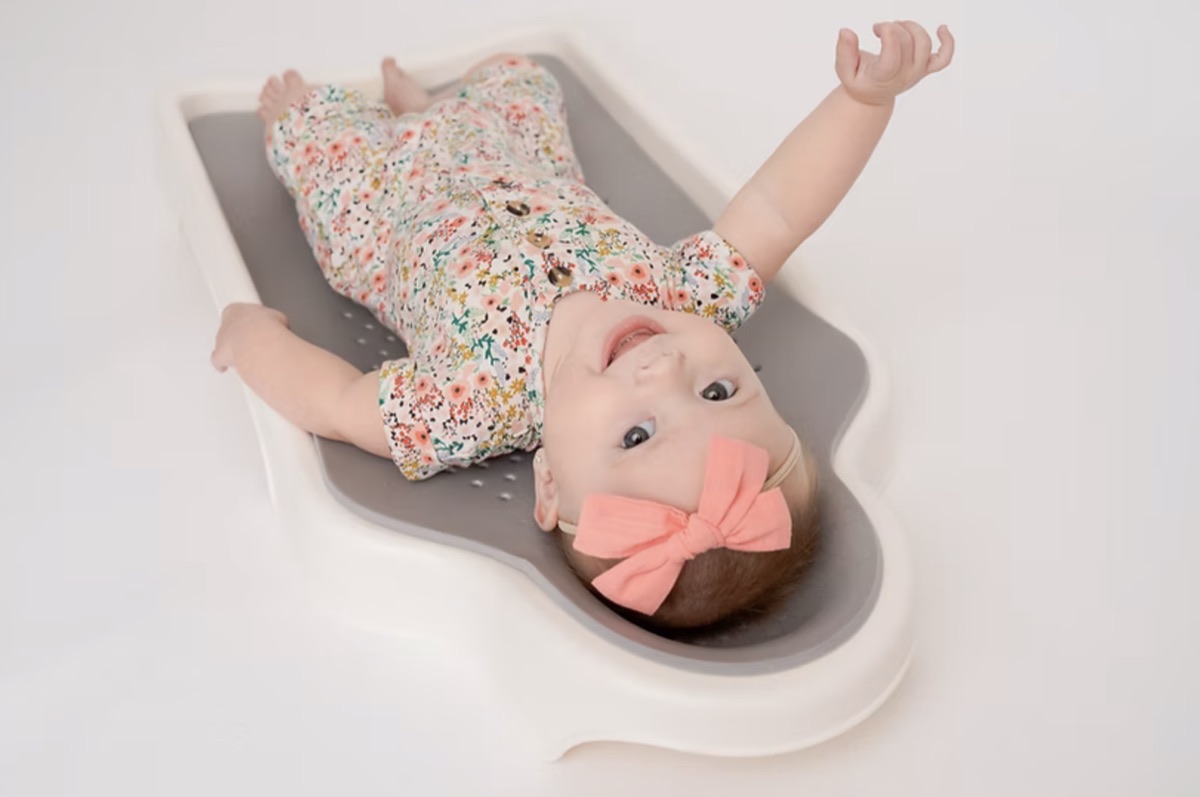
Intended mechanism (manufacturer statement). The manufacturer describes an anatomically shaped concave recess intended to cradle the head so that pressure rests on rounded areas rather than on a developing flat area, and states that the recess allows the head to remain symmetrical during early infancy. The manufacturer also describes an intended age range of roughly two to six months, adjusted for prematurity, and states that results are generally visible within six to eight weeks of consistent use. These are descriptions of intended function and manufacturer-reported experience, not independently verified clinical outcomes.
Regulatory status. Searches of the FDA 510(k) and registration databases returned no records for this product, so it should not be described as FDA cleared or approved.
Published evidence. We did not identify peer-reviewed clinical studies of Perfect Noggin indexed in PubMed. A described mechanism can sound entirely reasonable and still not have been tested. Absence of published studies is not evidence that a product fails; it means the question has not been answered in the literature that clinicians rely on.
Safe-sleep considerations. Because this product is the surface a baby sleeps on, safe-sleep guidance applies to it directly rather than incidentally. The AAP and CPSC advise a firm, flat, level, non-inclined sleep surface designed for the specific crib, bassinet, play yard, or other approved sleep product, covered only with a fitted sheet. Any contoured infant sleep surface should be discussed with your pediatrician, and parents should confirm that a product meets the requirements for the sleep product they intend to use it in.
Mimos Pillow
What it is. Mimos is an infant head-shaping pillow, placed beneath the baby's head.
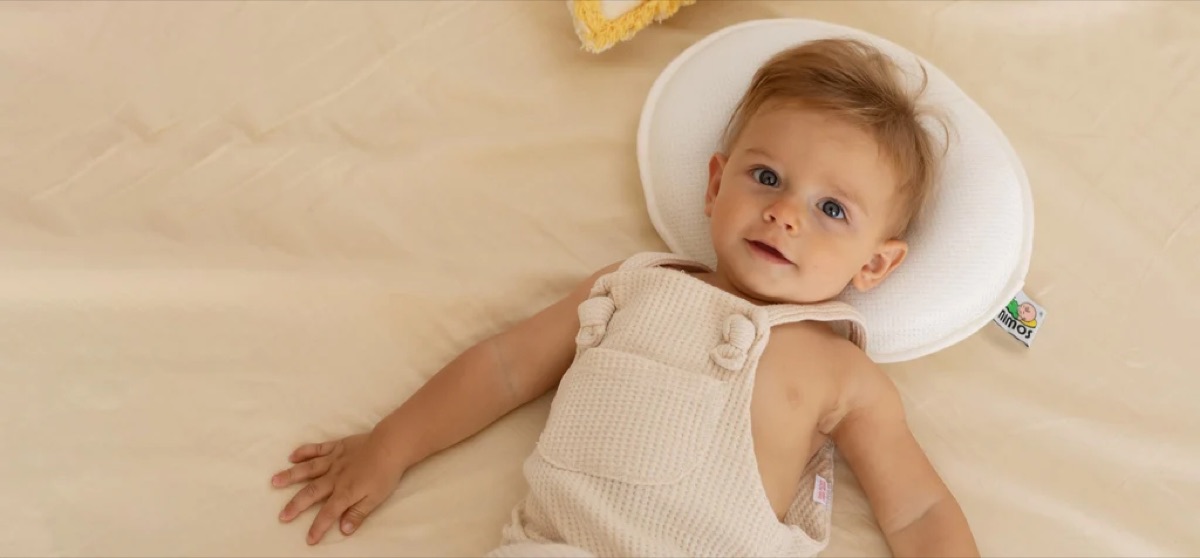
Intended mechanism (manufacturer statement). The manufacturer describes a patented breathable three-dimensional structure intended to spread contact pressure over a wider area of the head rather than concentrating it at one point, and describes the product as intended to help protect head shape.
European status (manufacturer statement). The manufacturer states Mimos is a CE-marked Class I medical device under EU Regulation 2017/745. We could not independently confirm this in a public EU registry, and as noted above, that class is self-certified and carries no United States status.
FDA status. Searches of the same two FDA databases returned no records for this product.
Published evidence. We did not identify peer-reviewed clinical studies of the Mimos pillow indexed in PubMed.
Current United States guidance on this product category. In a 2022 safety communication, the FDA advised parents and caregivers not to use infant head-shaping pillows to prevent or treat any medical condition, stating that it was not aware of demonstrated benefit from these pillows for preventing or treating positional skull deformities and that they may create an unsafe infant sleep environment. The AAP's HealthyChildren resource similarly states that head-shaping support pillows are not safe and notes the absence of evidence that they work.
This guidance is directed at the product category of infant head-shaping pillows, and Mimos is a product in that category. It is not a finding about one brand's manufacturing or materials.
Our separate guide covers this category in more detail: Do Baby Flat Head Pillows or Mattresses Work?
Tortle
What it is. The Tortle is a beanie worn on the baby's head, with a small roll positioned to encourage the head to turn toward a chosen side. It is not a pillow: nothing loose is placed in the sleep space, which is a genuine and relevant design difference.
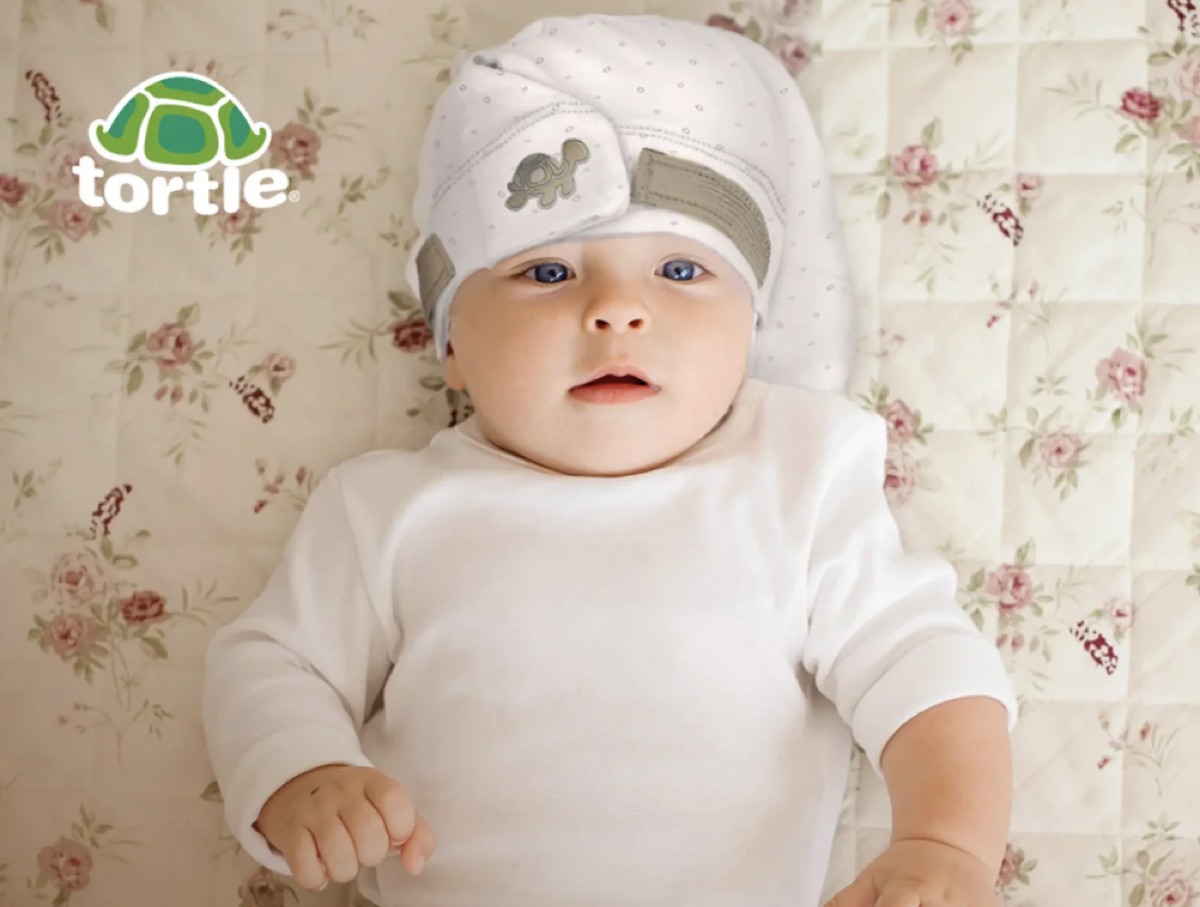
Intended mechanism. Rather than altering the surface the head rests on, it is intended to influence which way the head turns, so pressure is not repeatedly concentrated on the same area.
Regulatory status (verified in FDA records). This is the one product of the three with an FDA clearance on file: 510(k) K082367, “Infant Sleep Beanie,” found substantially equivalent on June 12, 2009. Tortle Products, LLC also appears as a registered establishment. Full identifiers are in the table above and in the references.
Worth being precise: at least one published paper on this device says FDA “approved” it. That is the wrong word, and a clearance is not a finding that the device prevents or treats plagiocephaly.
What the published studies actually show
McCarty et al., 2018 — cranial index in preterm infants
A non-randomized study of a midliner positioning system in premature infants compared 30 infants using the device with a retrospective cohort of 65 infants receiving standard care. Over roughly five to six weeks, cranial index in the comparison group decreased from 80% to 77% (P < .0001), while the device group's cranial index was 79% at both time points (P = .6), which the authors interpreted as prevention of the narrowing seen in the comparison group. The authors stated directly that a larger randomized study is needed before routine use can be recommended.
Limitations: not randomized; the comparison group was historical rather than concurrent; the population was premature infants in a neonatal unit; and the outcome was dolichocephaly, the long-narrow pattern common in that setting, rather than deformational plagiocephaly in term infants.
Mehmood et al., 2020 — neurodevelopmental scores in preterm infants
A retrospective chart review of 207 infants born at under 32 weeks and under 1500 g. Of these, 32 used the beanie; 31 were assessed at 12 months and 16 at 24 months. Bayley-III cognition scores at 12 months were higher among beanie users (P = 0.02), with no significant difference at 24 months, which the authors attributed to the smaller sample at that point.
Limitations: retrospective and not randomized, so families who used the beanie may have differed systematically from those who did not; the treated group was small and shrank at follow-up; and the primary outcome was a developmental score, not head shape. This study does not measure whether the device changed head shape, and its own concluding sentence reaches further than its design supports.
Taken together: the published work on this device is small, non-randomized, and confined to preterm infants in neonatal care. We did not identify a randomized controlled trial in term infants with deformational plagiocephaly.
What does the evidence actually tell us?
Being honest about evidence means being willing to say that a question has not been answered. Across all three products, that is largely the situation.
- Randomized evidence: we identified none for any of the three products.
- Observational evidence: exists only for Tortle, in two small non-randomized studies in preterm infants, one of which did not measure head shape.
- No identified published clinical evidence: Perfect Noggin and Mimos, based on our PubMed searches.
Because none of these products has been compared head-to-head in a trial, and two of them have no published clinical studies at all, there is no evidentiary basis for ranking them. Anyone presenting a ranking is expressing a preference, not reporting a finding. We are not going to declare a winner, and we would treat any source that does with caution.
A further point about interpreting product research generally: study sponsorship and author relationships matter, and readers should look for those disclosures. The Mehmood study states that no competing interests exist. The McCarty study did not include a conflict-of-interest statement in the record we reviewed. Neither of these facts changes the design limitations described above.
What do pediatric and neurosurgical guidelines recommend?
Where high-quality guidance does exist, it points away from products and toward positioning, evaluation, and therapy.
The Congress of Neurological Surgeons published a systematic review and evidence-based guideline series on positional plagiocephaly in 2016. Its repositioning chapter concluded, on Level I to III evidence, that repositioning education affords some degree of correction in virtually all infants with positional plagiocephaly or brachycephaly. Its physical therapy chapter concluded, on Level I to II evidence, that physical therapy is significantly more effective than repositioning education alone, and stated that physical therapy must be recommended over the use of a positioning pillow, citing AAP infant sleep safety concerns.
The AAP's guidance emphasizes back sleeping for every sleep on a firm, flat, non-inclined surface, supervised awake tummy time, and evaluation of a persistent head-turning preference or torticollis. The FDA guidance on head-shaping pillows is described above.
Products versus objective measurement
There is a category difference that is easy to miss when everything appears in the same search results. All three products above attempt to influence head positioning or head shape. Objective measurement does something entirely different: it quantifies head proportion and asymmetry so that change can be documented over time.
These are not competing answers to the same question. Measurement does not shape a head, and a product does not tell you whether a head shape is changing. Cranial Index and Cranial Vault Asymmetry Index describe proportion and side-to-side difference numerically, which is more consistent than judging by appearance across weeks when hair, viewing angle, lighting, and memory all interfere.
SoftSpot® is an FDA-cleared measurement tool designed to objectively measure and track infant head shape using measurements including CI and CVAI. It does not treat plagiocephaly or replace clinical evaluation. We are not claiming it is better than Perfect Noggin, Mimos, or Tortle. It does a different job, and a measurement tool and a positioning product are not substitutes for one another.
Frequently asked questions
Does Perfect Noggin work for flat head?
Perfect Noggin is designed with a contoured area to help redistribute pressure on a baby’s head. The design has a reasonable intended mechanism; however, currently there are no peer-reviewed clinical studies of Perfect Noggin indexed in PubMed. Therefore, a definitive statement about whether it can prevent or improve flat head cannot yet be made.
Is Perfect Noggin safe for sleep?
Perfect Noggin is a sleep surface, so infant safe-sleep guidance applies directly. The AAP and CPSC advise a firm, flat, level, non-inclined sleep surface intended for the specific crib, bassinet, or play yard, covered only by a fitted sheet. Parents considering any alternative or contoured infant sleep surface should discuss it with their pediatrician and confirm it meets applicable safe-sleep and product requirements.
Is the Mimos Pillow FDA approved or cleared?
A search of the FDA 510(k) database and the FDA establishment registration and device listing database did not return records for the Mimos Pillow. The manufacturer states the product is a Class I medical device bearing a CE mark under EU Regulation 2017/745. European CE marking is not FDA clearance or FDA approval, and the two are not interchangeable.
Is Mimos safe for babies?
Mimos is a pillow. The FDA has advised parents and caregivers not to use infant head-shaping pillows to prevent or treat any medical condition, stating it is not aware of demonstrated benefit and that these products may create an unsafe infant sleep environment. The AAP likewise advises against pillows in an infant sleep space. Discuss any product intended for your baby with your pediatrician.
Is Tortle FDA cleared?
Yes. FDA records show 510(k) number K082367 for the device name "Infant Sleep Beanie," submitted by Life Innovations, LLC, with a decision of Substantially Equivalent dated June 12, 2009, under product code FRP.
Does Tortle prevent plagiocephaly?
The available published studies do not establish that. The two studies we identified were conducted in preterm infants, were small, and were not randomized. One measured neurodevelopmental scores rather than head shape; the other measured cranial index for prevention of dolichocephaly and its authors explicitly stated that a larger randomized study is needed before routine use can be recommended.
What is the difference between Tortle and a head-shaping pillow?
A head-shaping pillow is an object placed in the sleep space beneath the baby. The Tortle is a beanie worn on the head with a small roll intended to encourage the head to turn to a chosen side, so nothing loose is added to the sleep surface. That is a meaningful difference for safe-sleep purposes.
Are flat-head pillows recommended by pediatricians?
No. The AAP advises against pillows in an infant sleep space and states that head-shaping support pillows are not safe, noting the lack of evidence that they work for positional skull deformities. The Congress of Neurological Surgeons guideline on physical therapy likewise states that physical therapy must be recommended over the use of a positioning pillow, citing AAP infant sleep safety concerns.
What does the FDA say about baby head-shaping pillows?
In a 2022 safety communication, the FDA advised parents and caregivers not to use infant head-shaping pillows to prevent or treat any medical condition, including flat head syndrome and plagiocephaly. The agency stated it was not aware of demonstrated benefit from these pillows and warned that they may create an unsafe sleep environment.
How can I objectively track whether my baby's head shape is improving?
Objective measurements such as Cranial Index and Cranial Vault Asymmetry Index describe head proportion and asymmetry numerically, which is more consistent than judging by appearance across weeks. Measurements document change; they do not diagnose a condition or determine treatment, and should be interpreted by a healthcare provider alongside examination and history.
Related reading
References
- U.S. Food and Drug Administration. 510(k) Premarket Notification K082367: Infant Sleep Beanie (openFDA 510(k) database record). Applicant: Life Innovations, LLC. Decision: Substantially Equivalent, June 12, 2009. Product code FRP.
- U.S. Food and Drug Administration. Device classification for product code FRP: device name “Holder, Infant Position,” regulation number 880.5680, Class 1 (openFDA device classification database).
- U.S. Food and Drug Administration. Do Not Use Infant Head Shaping Pillows to Prevent or Treat Any Medical Condition: FDA Safety Communication. Issued November 3, 2022. FDA removed the page from its site in early 2025; this link is the archived copy captured December 16, 2024.
- American Academy of Pediatrics, HealthyChildren.org. When a Baby's Head Is Misshapen: Positional Skull Deformities.
- U.S. Consumer Product Safety Commission. Safe Sleep—Cribs and Infant Products.
- Klimo P Jr, Lingo PR, Baird LC, et al. Congress of Neurological Surgeons Systematic Review and Evidence-Based Guideline on the Management of Patients With Positional Plagiocephaly: The Role of Repositioning. Neurosurgery. 2016;79(5):E627-E629. PMID: 27776087.
- Baird LC, Klimo P Jr, Flannery AM, et al. Congress of Neurological Surgeons Systematic Review and Evidence-Based Guideline for the Management of Patients With Positional Plagiocephaly: The Role of Physical Therapy. Neurosurgery. 2016;79(5):E630-E631. PMID: 27776088.
- McCarty DB, O'Donnell S, Goldstein RF, Smith PB, Fisher K, Malcolm WF. Use of a Midliner Positioning System for Prevention of Dolichocephaly in Preterm Infants. Pediatr Phys Ther. 2018;30(2):126-134. PMID: 29579000.
- Mehmood N, Hasan A, Nwanne O, et al. Impact of the Use of the Beanie on the Neurodevelopmental Outcomes of Preterm Infants With Plagiocephaly: A Pilot Study. Cureus. 2020;12(6):e8716. PMID: 32699711.
- European Union. Regulation (EU) 2017/745 on medical devices.
- U.S. Food and Drug Administration. 510(k) Summary K212045: SoftSpot Cranial Measurement Software.
Product descriptions attributed to manufacturers were taken from the manufacturers' own published materials and are identified as such in the text. FDA database searches were performed on September 2, 2026.