
Parent safe-sleep guide
Do Baby Flat Head Pillows or Mattresses Work?
Products marketed to round a baby's head can sound reassuring. Safe-sleep guidance and clinical evidence tell a different story: keep pillows and positioners out of the sleep space, and discuss head-shape concerns with a healthcare provider.
Reviewed by the SoftSpot Clinical & Scientific Team
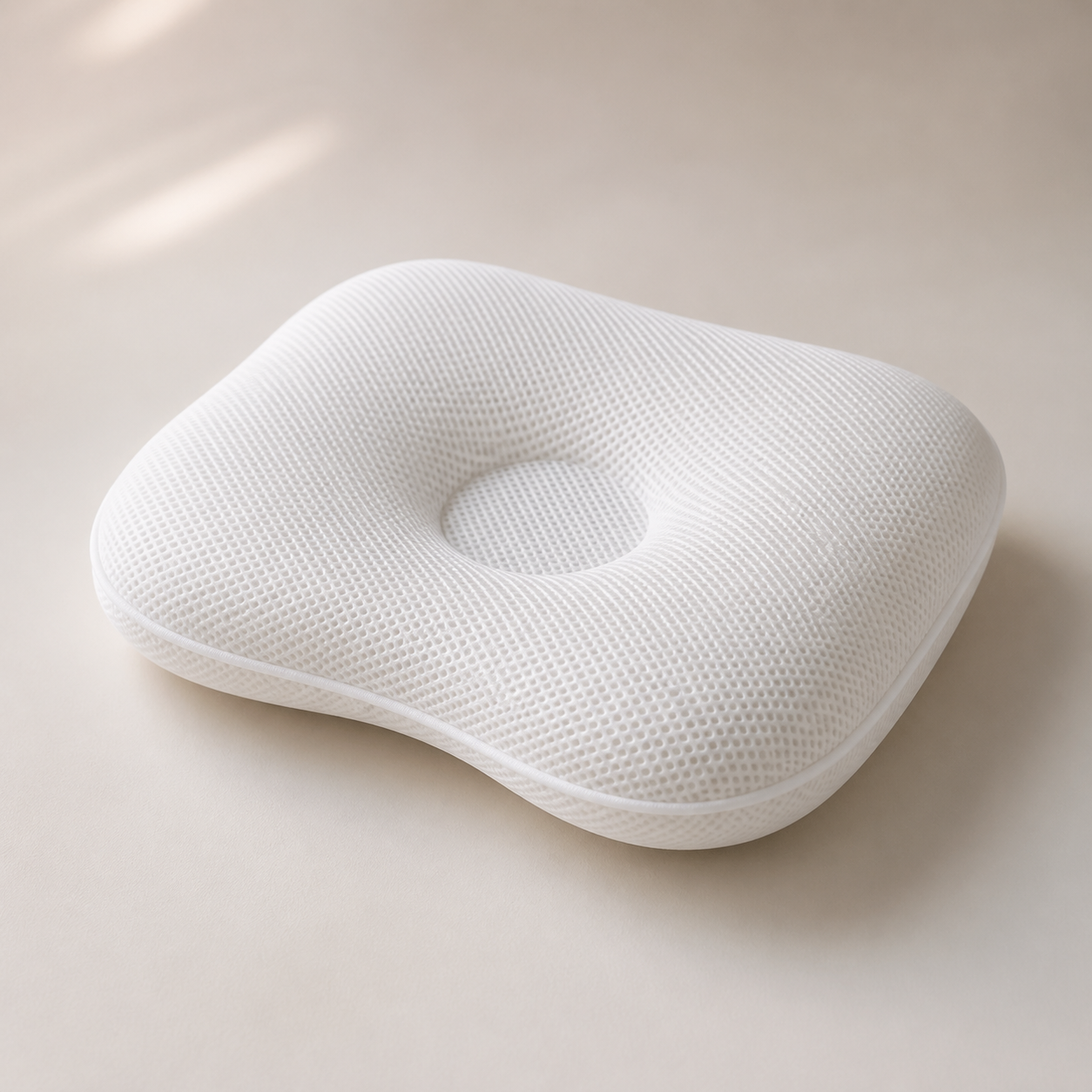
Why are “flat head” pillows so popular?
Parents naturally want a simple answer when they notice a flat area or worry that a baby's head is not becoming rounder. A baby flat head pillow can look easy to use, relatively inexpensive, and less intimidating than a medical appointment. Product photos, testimonials, star ratings, and phrases such as “ergonomic” or “doctor designed” can make a marketing claim feel authoritative.
Online popularity is not clinical evidence. Reviews cannot show whether a product caused a change, whether normal growth or increased mobility was responsible, or whether the starting head shape was accurately assessed. A listing also does not establish that a baby head shaping pillow is safe for sleep, FDA approved, FDA cleared, or clinically effective.
Three product names come up most often in parent searches: Perfect Noggin, Mimos and Tortle. They are not the same kind of product, and their regulatory records differ. See Perfect Noggin, Mimos & Tortle: what parents should know.
Do baby head-shaping pillows actually work?
The FDA's safety communication advises parents not to use infant head-shaping pillows to prevent or treat any medical condition. The agency reported that it was not aware of demonstrated benefit from these pillows for preventing or treating positional skull deformities, including plagiocephaly and brachycephaly.
HealthyChildren, the AAP's parent resource, likewise says head-shaping support pillows are not safe and notes the lack of evidence that they work for positional skull deformities. That distinction matters: a package can claim to redistribute pressure or promote a round head, but a plausible explanation is not proof of meaningful, safe medical benefit.
Do not treat “sold for infants,” “medical grade,” or similar wording as regulatory authorization. Avoid relying on a flat head prevention pillow in place of evaluation, safe awake-time strategies, or clinical follow-up.
Are flat-head pillows safe for sleep?
No pillow belongs in an infant sleep space. Young babies may not be able to move away if their nose or mouth presses against a soft object. Pillows and positioning devices can contribute to suffocation, entrapment, or an unsafe head and neck position.
CPSC's “Bare is Best” guidance says a crib, bassinet, or play yard should contain nothing but a fitted sheet. It specifically advises caregivers not to add pillows, blankets, or sleep positioners and to place babies on their backs. A product marketed as a plagiocephaly pillow, brachycephaly pillow, baby pillow for a round head, lounger, wedge, or positioner does not create an exception to that guidance.
What about special mattresses for flat head?
The word “mattress” covers very different products. An infant still needs a mattress—but it should be firm, flat, level, non-inclined, tight fitting, and intended for the specific crib, bassinet, play yard, or approved sleep product. Use only a fitted sheet made for that mattress.
A product marketed as a baby flat head mattress does not automatically have evidence that it prevents or treats positional skull deformity. Safe-sleep compatibility and compliance with the applicable sleep-product requirements come first. Do not add or substitute a soft mattress, memory-foam surface, pillow-top surface, mattress topper, wedge, pillow under the baby, positioning device, or anything that creates an inclined, contoured, or hammock-like surface.
Do not place extra material under a fitted sheet to change pressure. Even hidden padding changes the sleep surface. When uncertain whether a mattress fits or is intended for the product, consult the sleep-product manufacturer's instructions and current CPSC guidance.
What should parents do instead?
Continue placing your baby on their back for every sleep. During awake, directly supervised periods, offer regular tummy time. Start with manageable sessions and build according to your baby's abilities and pediatrician's guidance.
- Vary holding and feeding positions when appropriate.
- Reduce unnecessary awake time in car seats, swings, and similar devices that press on the same part of the head.
- Encourage looking in different directions with caregiver position, light, or age-appropriate toys during supervised awake time.
- Notice whether your baby consistently turns one way or seems unable to turn comfortably both ways.
- Discuss possible torticollis and persistent head-shape differences with a healthcare provider.
For a step-by-step version of these habits, including when to ask about physical therapy, read how to help a baby's flat head without a helmet.
These are general educational strategies, not an individual treatment plan. Read Is My Baby's Head Shape Normal? for a parent-friendly overview.
Don't just look—measure and track
Parents often buy head-shaping products because they are unsure whether their baby's head shape is improving. Instead of relying only on appearance or claims made by head-shaping products, objective measurements can help document head shape and changes over time.
Cranial Index (CI) describes width relative to length, while Cranial Vault Asymmetry Index (CVAI) describes side-to-side asymmetry. The existing SoftSpot report guide explains how to read those values.
SoftSpot® is an FDA-cleared measurement tool that helps parents objectively measure and track infant head shape using a smartphone, including measurements such as CI and CVAI. It complements—not replaces—a healthcare provider's clinical evaluation and does not prevent, diagnose, or determine treatment for plagiocephaly.
Why early recognition matters
A retrospective study of more than 25,000 children with positional plagiocephaly found that diagnosis after 6 months was associated with greater likelihood of referral for helmet evaluation and of requiring helmet therapy compared with diagnosis by 6 months. The study shows an association; it does not prove that early recognition prevents helmet therapy.
The useful takeaway is to raise concerns, measure objectively when appropriate, track change, and discuss the complete picture with a provider—not to buy an unproven sleep product. Learn more in the plagiocephaly guide and baby helmet guide.
Frequently asked questions
Do baby flat-head pillows work?
The FDA states that it is not aware of demonstrated benefit from infant head-shaping pillows for preventing or treating positional skull deformities. The AAP advises against them because pillows create an unsafe infant sleep environment.
Are head-shaping pillows FDA approved?
Do not assume a product is FDA approved or cleared because it is sold online or uses medical-sounding language. FDA has advised parents not to use infant head-shaping pillows to prevent or treat a medical condition and says it is not aware of demonstrated benefit.
Are pillows for plagiocephaly safe?
Pillows should not be placed in an infant sleep space. They are soft objects that can contribute to suffocation risk. Speak with a healthcare provider about plagiocephaly rather than adding a pillow or positioner.
Can a pillow make my baby's head round?
There is no demonstrated medical benefit showing that a head-shaping pillow safely prevents or treats positional skull deformity. Head shape also cannot be diagnosed or followed reliably from appearance alone.
What kind of mattress is best for a baby with a flat head?
Use a firm, flat, level, non-inclined mattress designed to fit the specific crib, bassinet, play yard, or other approved sleep product, covered only by a fitted sheet. Do not add padding, toppers, wedges, pillows, or positioners.
Does a special mattress prevent flat head?
Strong evidence does not establish that a specially marketed flat-head mattress prevents or treats plagiocephaly. Safe-sleep requirements come first. Ask your pediatrician about persistent head-shape concerns.
What can I do instead of using a flat-head pillow?
Continue back sleeping, and use supervised awake tummy time, varied holding and feeding positions, less unnecessary awake time in devices that press on the same area, and evaluation of a persistent turning preference or torticollis.
Should my baby sleep differently if they have a flat head?
No. Continue placing your baby on their back for every sleep on a firm, flat, non-inclined surface with only a fitted sheet. Never use side or stomach sleeping as a flat-head treatment unless a qualified clinician provides different instructions for a specific medical reason.
How can I tell if my baby's head shape is improving?
Consistent observation and objective measurements can help document change over time. CI describes width relative to length, while CVAI describes asymmetry. Measurements complement—not replace—a healthcare provider’s evaluation.
References
- U.S. Food and Drug Administration. Do Not Use Infant Head Shaping Pillows to Prevent or Treat Any Medical Condition: FDA Safety Communication. Issued November 3, 2022. FDA removed the page from its site in early 2025; this link is the archived copy captured December 16, 2024.
- American Academy of Pediatrics, HealthyChildren.org. When a Baby's Head Is Misshapen: Positional Skull Deformities.
- U.S. Consumer Product Safety Commission. Safe Sleep—Cribs and Infant Products.
- Munabi CO, Nelson MS, Francis SH. Risk Factors for Delayed Diagnosis of Positional Plagiocephaly: A Review of 25,322 Patients. Cleft Palate Craniofac J. 2024;61(10):1679-1686. PMID: 37248557.
- U.S. Food and Drug Administration. 510(k) Summary K212045: SoftSpot Cranial Measurement Software.