
Parent development guide
Tummy Time for Babies: When to Start, How Much, and How to Make It Easier
Tummy time is one of the first things parents are told to do and one of the first things babies protest. Here is what the guidance actually says, how much to aim for as your baby grows, and practical ways to get through the fussy early weeks.
Reviewed by the SoftSpot Clinical & Scientific Team
Why tummy time matters
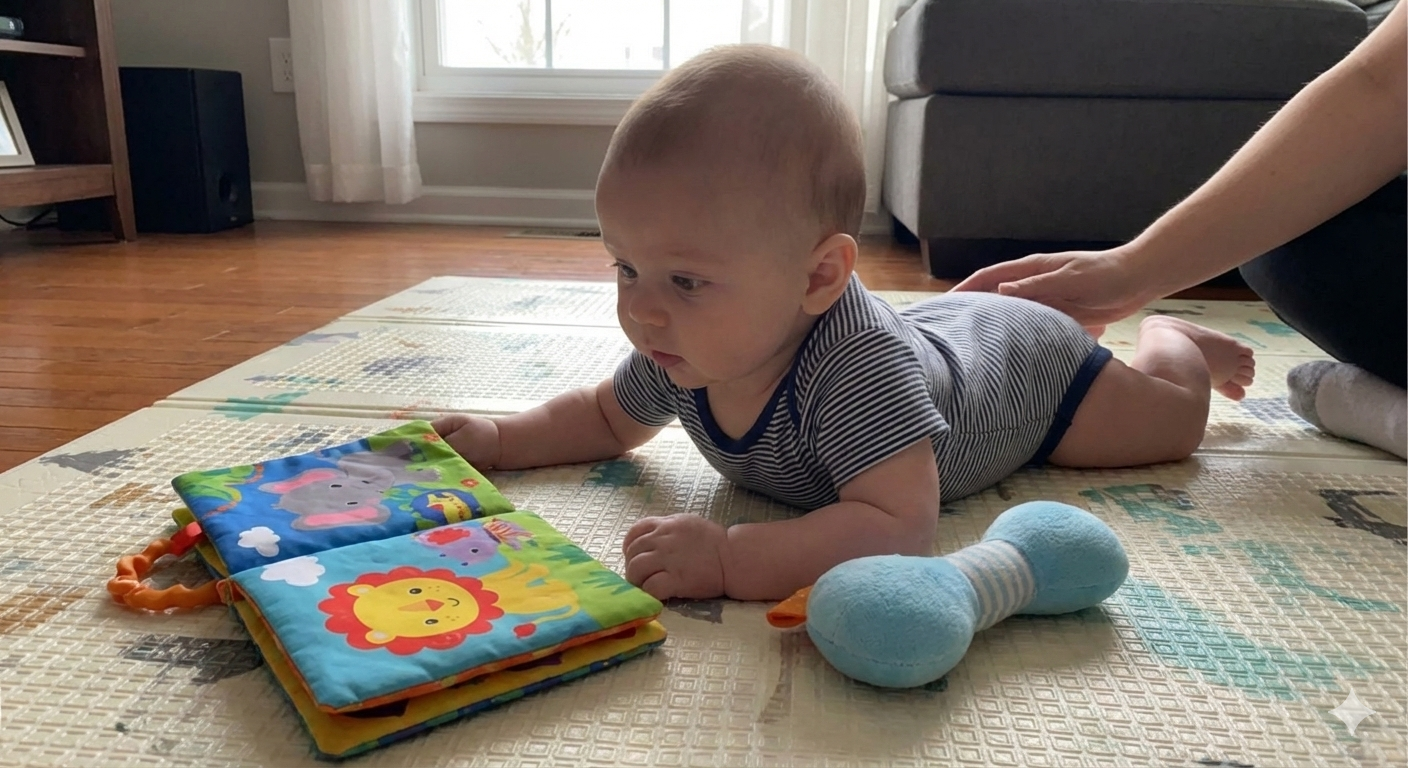
Since babies sleep on their backs, much of their day is spent lying the same way. Tummy time gives them a different position while they are awake. Lifting and turning the head, pushing up on the arms, and reaching for toys build the neck, shoulder, arm, and core strength that later goes into rolling, sitting, and crawling.
It also gives the back of the head a break. When a baby spends long stretches on their back, the same part of the skull carries their weight, which is one of the reasons flat spots develop.
The research supports this. A 2020 systematic review in Pediatrics found that tummy time was linked with better gross motor development and overall development, and with less brachycephaly (flattening across the back of the head). Most of the studies it pooled were observational, so they show an association rather than proof of cause, but the direction is consistent.
One thing tummy time is not: the NIH Safe to Sleep campaign notes that it does not directly lower the risk of sudden infant death syndrome (SIDS). Back sleeping does that. Tummy time is about development.
When to start tummy time
Earlier than many parents expect. HealthyChildren.org, the American Academy of Pediatrics' site for parents, says you can start the day your baby comes home from the hospital. The NIH Safe to Sleep campaign says most babies can start a day or two after birth.
In the first weeks, tummy time rarely looks like a baby on a play mat. It is usually a baby lying on your chest while you recline, or across your lap for a minute or two. That is enough to start.
If your baby was born early, spent time in the NICU, has reflux that makes lying on the tummy uncomfortable, or has any medical condition, ask your baby's care team when and how to begin.
How much tummy time by age
Different organizations phrase it differently, but they point the same way: start with a few minutes at a time and build toward about half an hour a day, spread across several short sessions.
| Age | General guidance | Source |
|---|---|---|
| First days home | About 3 to 5 minutes, 2 to 3 times a day | AAP (HealthyChildren.org) |
| 7 weeks to about 2 months | 15 to 30 minutes a day in total | AAP; NIH Safe to Sleep |
| Until your baby is mobile | At least 30 minutes a day, spread through the day | World Health Organization |
| Rolling and crawling | Plenty of floor play several times a day | World Health Organization |
Treat these as starting points rather than a test your baby has to pass. Add time gradually as your baby shows they can handle it, and ask your pediatrician what fits your baby.
What tummy time is building toward
The CDC lists movement milestones that most babies (75% or more) reach by each age. Several of them happen on the tummy:
| By age | What most babies do on their tummy |
|---|---|
| 2 months | Holds head up when on tummy |
| 4 months | Pushes up onto elbows or forearms when on tummy |
| 6 months | Pushes up with straight arms when on tummy, and rolls from tummy to back |
Babies get there at their own pace. If your baby has not reached these, or seems to be losing skills they had, the CDC's advice is to talk to your pediatrician and not wait.
Tummy time positions that make it easier
Tummy time does not have to start flat on the floor. These positions all put your baby on their front, and you can mix them through the day.
- Chest to chest. Lean back on a couch or bed and lay your baby on your chest. They will try to lift their head to see your face. The more upright you sit, the easier it is for them.
- Across your lap. Lay your baby tummy-down across your knees, with a hand on their back. Good for calming after a diaper change.
- Tummy-down carry. Carry your baby face-down along your forearm with your other hand under their chest, sometimes called a football hold.
- On the floor with a little lift. On a firm, flat surface, a small rolled-up towel or blanket under the chest makes it easier to push up. Use it only while your baby is awake and you are right there, and put it away afterward.
- Eye-level floor play. Lie down facing your baby, or put a toy or baby-safe mirror at eye level in front of them. The CDC suggests toys at eye level to help babies practice lifting their heads.
Side-lying play is a useful in-between position too. On their side, babies can bring their hands together and look at a toy without the back of the head on the floor. Practice on both sides.
What to do if your baby hates tummy time
Almost every parent hits this. Lifting a heavy head against gravity is hard work for a newborn, and fussing is normal early on. Some things that help:
- Go shorter and more often. One minute, several times a day, adds up and ends before the crying starts.
- Pick a good moment. After a nap or a diaper change usually works better than when your baby is tired, hungry, or has just had a big feed.
- Start on your chest. Your face is the most interesting thing your baby can look at.
- Get down to their level. Lie on the floor facing them, sing, talk, and make faces.
- Give them something to look at. A baby-safe mirror, a high-contrast book, or a toy moved slowly from side to side.
- Make it a routine. A few minutes after every diaper change is easier to remember than a daily total.
- Stop before it turns into a meltdown, and try again later. Progress comes from repetition, not from pushing through crying.
Most babies tolerate tummy time better as they get stronger. If your baby always seems uncomfortable, always turns their head to the same side, or is not lifting their head as expected, mention it to your pediatrician.
Keeping tummy time safe
- Stay with your baby the whole time, and stay awake yourself during chest-to-chest time.
- Use a firm, flat surface. The floor is safer than a bed, couch, or changing table.
- If your baby gets sleepy, move them onto their back in their own sleep space.
- Keep pets, older siblings, and small objects away from the play area.
- Keep rolled towels, pillows, and positioners out of the crib. They belong to supervised awake time only, if at all.
Tummy time and flat head
Tummy time is one of the everyday habits that keep the back of the head from bearing pressure all day. That is why it shows up in almost every discussion of plagiocephaly and brachycephaly, alongside changing how you hold, feed, and carry your baby.
If you already see a flat spot, tummy time is still worth doing, but it is not the whole answer. A baby who always turns their head one way may have tight neck muscles (torticollis), and that is worth having examined. And because a head shape is hard to judge by eye from week to week, measuring it gives you and your provider something more reliable to compare.
Track tummy time with TummySpot
The hardest part of tummy time is not any one session. It is remembering to do it several times a day, every day, and knowing whether it is adding up. TummySpot is a free tummy time companion on SoftSpot Connect, built by PediaMetrix, the team behind the SoftSpot head-shape measurement app. It runs in your phone's browser, and you can add it to your home screen.
One-tap timer
Start and stop each session with one tap. No account needed.
Daily goal and history
With a free parent account, set a daily goal and see the last 7 days at a glance.
Short video lessons
Watch a quick lesson, then practice it with your baby.
The lessons follow the positions in this guide: easier ways to start tummy time, encouraging your baby to look both ways, side-lying play, rolling through play, different ways to hold and carry, and safe sleep. One lesson shows how to take a baseline head-shape measurement with SoftSpot, so you have something to compare against later.
When to talk to your pediatrician
Bring it up at your next well-child visit, or sooner, if your baby:
- is not reaching the tummy milestones above for their age, or is losing skills they had
- always turns or tilts their head to the same side
- seems uncomfortable on their tummy in a way that does not ease with practice
- has a flat spot, or a head shape that seems to be changing
Frequently asked questions
When should I start tummy time with my baby?
The American Academy of Pediatrics’ parent site, HealthyChildren.org, says you can start tummy time the day your baby comes home from the hospital, and the NIH Safe to Sleep campaign says most babies can start a day or two after birth. Early sessions can be very short and can happen on your chest. If your baby was born early, spent time in the NICU, or has a medical condition, ask your baby’s care team when and how to begin.
How much tummy time does a newborn need?
HealthyChildren.org suggests starting with about 3 to 5 minutes, 2 to 3 times a day, and adding more as your baby gets used to it. A few minutes at a time is normal at first, and time on your chest counts.
How much tummy time should a 2-month-old get?
HealthyChildren.org says to work up to 15 to 30 minutes a day by 7 weeks, and the NIH Safe to Sleep campaign gives the same 15 to 30 minutes by about 2 months. That is a daily total built from several short sessions, not one long one. The World Health Organization recommends at least 30 minutes spread through the day for babies who are not yet moving around on their own.
Does tummy time on my chest count?
Yes. Lying back with your baby on your chest is one of the positions HealthyChildren.org describes, and babies often lift their heads to see your face. Lap time and tummy-down carries also give your baby practice on their front. Your baby needs to be awake, and you need to be awake and watching.
What if my baby hates tummy time?
Many babies fuss at first, because lifting the head is hard work. Try shorter sessions more often, start on your chest, get down at eye level, use a mirror or a favorite toy, and pick a time when your baby is rested and not just after a big feed. Short sessions still count. If your baby always seems uncomfortable on their tummy or always turns their head the same way, mention it to your pediatrician.
Can tummy time help prevent a flat head?
Tummy time takes pressure off the back of the head during awake hours. A 2020 systematic review in Pediatrics linked tummy time with less brachycephaly (flattening across the back of the head) and with better motor development, although most of the studies were observational. A flat spot that is not improving should still be looked at by a healthcare provider.
What if my baby falls asleep during tummy time?
Move your baby onto their back in their own safe sleep space. Tummy time is only for when your baby is awake and someone is watching. Babies should be placed on their backs for every sleep, on a firm, flat surface with nothing else in the sleep space.
When can my baby stop doing tummy time?
There is no set end date. Once babies can roll, push up, and start to crawl, they usually spend plenty of floor play on their tummies on their own. World Health Organization guidance for babies under 1 emphasizes interactive floor-based play several times a day and suggests not keeping babies in strollers, high chairs, or carriers for more than 1 hour at a time.
Is there a free app to track tummy time?
TummySpot is a free tummy time tracker on SoftSpot Connect that runs in your phone’s browser. You can time a session with one tap without an account, and with a free parent account you can set a daily goal and keep a history with a 7-day view. It also has short video lessons with tummy time positions and play ideas. TummySpot is educational and does not give medical advice.
References
- American Academy of Pediatrics, HealthyChildren.org. Back to Sleep, Tummy to Play.
- National Institute of Child Health and Human Development, Safe to Sleep campaign. Tummy Time.
- Moon RY, Carlin RF, Hand I; Task Force on Sudden Infant Death Syndrome and the Committee on Fetus and Newborn. Sleep-Related Infant Deaths: Updated 2022 Recommendations for Reducing Infant Deaths in the Sleep Environment. Pediatrics. 2022;150(1):e2022057990. PMID: 35726558.
- World Health Organization. To grow up healthy, children need to sit less and play more. April 24, 2019. Summary of the WHO Guidelines on physical activity, sedentary behaviour and sleep for children under 5 years of age.
- Centers for Disease Control and Prevention. Milestones by 2 months, 4 months, and 6 months. Learn the Signs. Act Early.
- Hewitt L, Kerr E, Stanley RM, Okely AD. Tummy Time and Infant Health Outcomes: A Systematic Review. Pediatrics. 2020;145(6):e20192168. PMID: 32371428.