Parent head-shape guide
How Can You Help a Baby's Flat Head Without a Helmet?
Most parents asking this question are not trying to avoid care. They want to know what is reasonable to do first, what actually has evidence behind it, and how to tell whether it is working.
Reviewed by the SoftSpot Clinical & Scientific Team
Step 1 — Understand what head shape you are seeing
Two patterns come up most often. Plagiocephaly describes asymmetry, usually with one side of the back of the head flatter than the other. Brachycephaly describes broader flattening across the back, so the head can look proportionally wide and short. A baby can show features of both, and the distinction matters because it shapes what a clinician looks for.
For the full picture, see Is My Baby's Head Shape Normal?, Plagiocephaly in Babies, and Brachycephaly in Babies.
One thing to rule in or out first: craniosynostosis, the early closure of a skull suture, is a structural condition rather than a positional one. It does not respond to repositioning and requires clinical evaluation. Parents cannot reliably distinguish it at home, which is why an unusual head shape — particularly one present from birth, worsening rather than improving, or accompanied by a firm ridge — should be examined by a provider before you settle into a home routine.
Step 2 — Start supervised awake tummy time
Tummy time does three useful things at once. It takes pressure off the back of the head during awake periods, it builds neck and upper-body strength, and it gives your baby practice moving the head in different directions rather than resting in one habitual position.
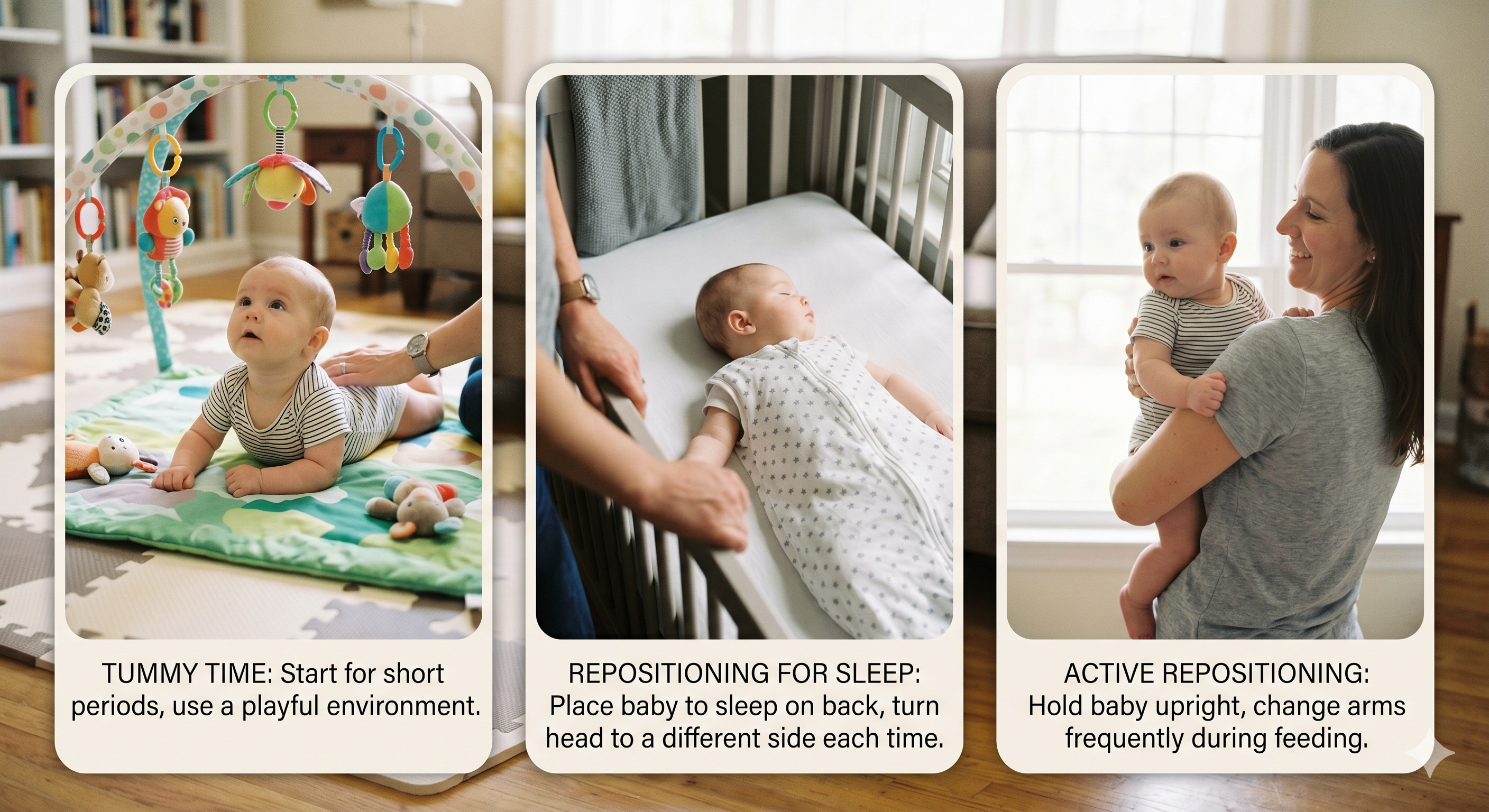
Practical ways to fit it into a day: a short session after each nappy change, time on a caregiver's chest or across the lap for babies who resist the floor, and play on a firm surface with a caregiver at eye level. Short and frequent generally works better than one long session. Build gradually according to your baby's tolerance, and ask your pediatrician what is appropriate for your baby's age and development.
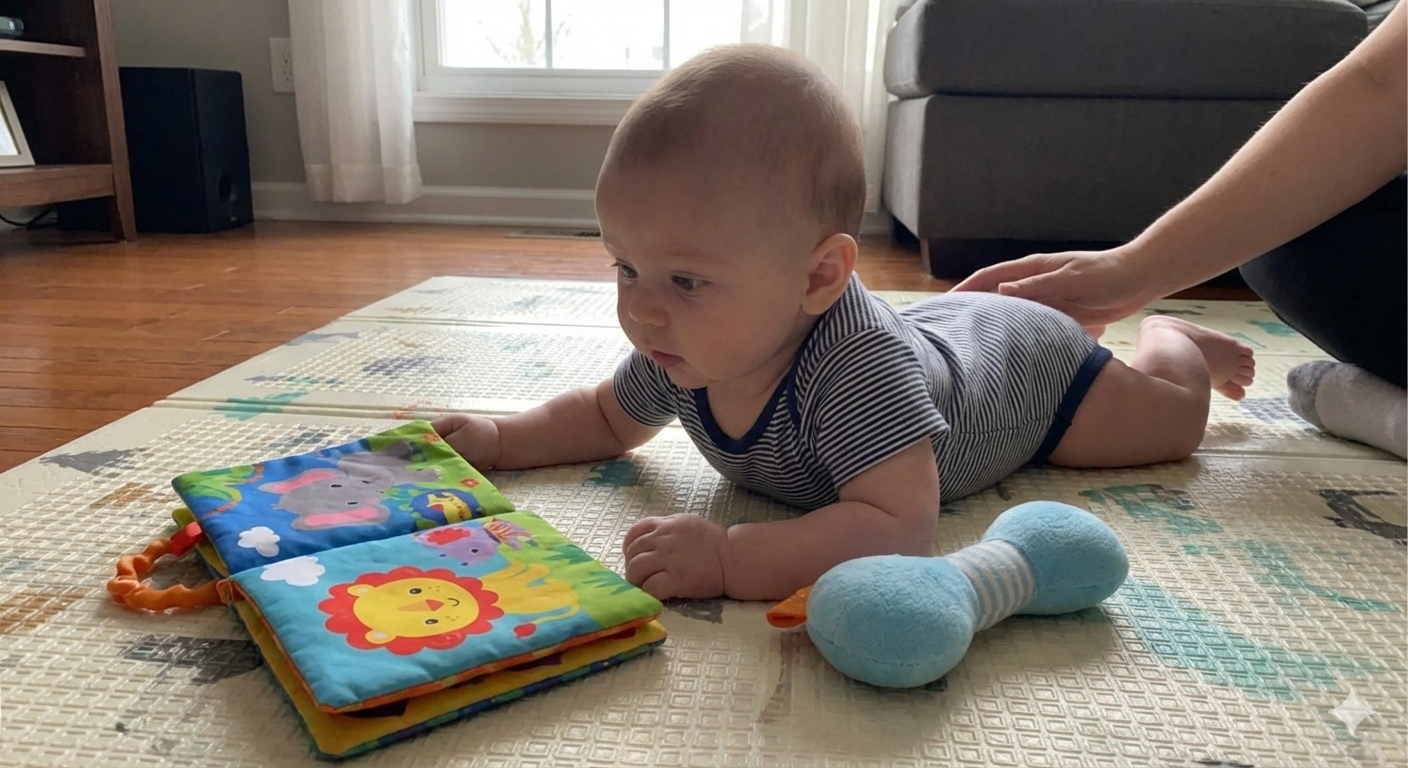
Our tummy time resource has detailed guidance.
Step 3 — Vary positioning while your baby is awake
The goal is simple: reduce how often the same part of the head bears pressure during awake hours. Small, repeated changes matter more than any single technique.
- Alternate arms during bottle feeding rather than always using the same side.
- Vary how you hold and carry your baby across the day.
- Change where interesting toys, lights, or people are positioned so your baby has reason to look both ways.
- Move yourself, rather than your baby's head, to encourage turning toward the less-preferred side during play.
- Alternate which end of the crib or bassinet your baby's head points toward. Babies tend to turn toward the door, window, or whoever walks in, so changing the orientation gives them a reason to look the other way — while still sleeping on their back.
- Reduce unnecessary awake time in car seats, swings, bouncers, and carriers when they are not needed for travel or care.
What this does not mean: do not place a baby on the side or stomach to sleep, and do not add sleep positioners, wedges, pillows, or rolled materials to the sleep space. Repositioning belongs to awake, supervised time. If a clinician who has examined your baby suggests a positioning support such as a small rolled towel, that instruction applies to awake, directly supervised play only — never to the crib, bassinet, or any sleep surface, and never to a car seat unless the car seat manufacturer or a qualified professional says otherwise.
Step 4 — Look for a head-turning preference or torticollis
This step is often the one that changes the outcome. If a baby consistently prefers to look one way, or finds it difficult to turn toward one side, the same area of the skull keeps bearing pressure no matter how diligently a family repositions. Torticollis, a neck-muscle imbalance, is a common reason for that pattern, and head asymmetry can in turn reinforce a preferred resting position.
Signs worth mentioning to your provider include a head that is regularly tilted to one side, turning that looks easier in one direction than the other, apparent discomfort when turning one way, or a strong and consistent preference during both feeding and play.
We are deliberately not providing stretching instructions here. Neck stretches for infants should be taught and supervised by a qualified clinician who has examined your baby, because technique and appropriateness depend on the individual examination. See our torticollis resource and raise it at your next visit.
Step 5 — Consider pediatric physical therapy when appropriate
A pediatric physical therapist typically assesses neck range of motion, positional preference, motor development, and overall movement patterns, then works with families on positioning strategies suited to that specific baby. When torticollis or a persistent positional preference is present, that professional input is often what allows repositioning to actually work.
Occupational therapy is sometimes part of the picture as well, particularly when feeding, sensory, or developmental play challenges accompany the positioning concern. Your provider can advise which discipline fits your baby's situation. This is not only clinical convention. The Congress of Neurological Surgeons' evidence-based guideline series on positional plagiocephaly concluded, on Level I to II evidence, that physical therapy is significantly more effective than repositioning education alone. The same series concluded, on Level I to III evidence, that repositioning education affords some degree of correction in virtually all infants with positional plagiocephaly or brachycephaly. Both are worth knowing: repositioning helps, and professional guidance helps more.
Step 6 — Measure instead of relying only on appearance
Here is a problem almost every family runs into. You look at your baby every day, which makes gradual change nearly impossible to perceive. Hair grows in. Photographs get taken from different angles, in different light, with the head turned differently. Memory fills in the rest. Two months later, parents genuinely cannot tell whether anything has changed, and neither can a relative looking at phone photos.
Objective measurement solves a narrow but important part of this: it produces numbers that can be compared across time. Cranial Index (CI) describes width relative to length. Cranial Vault Asymmetry Index (CVAI) describes the difference between two diagonals across the head, which is how side-to-side asymmetry is quantified.
Step 7 — Track whether head shape is actually changing
A single measurement is a snapshot. What is genuinely useful is a series: the same measurement, captured the same way, at intervals. That is what lets a family and a provider see whether a head shape appears stable, improving, or changing in a direction that warrants another conversation.
Tracking is information gathering, not diagnosis. A trend does not establish a cause, determine severity on its own, or decide whether treatment is needed. It gives your provider something more consistent than appearance to interpret alongside examination, growth, neck movement, and history.
SoftSpot® is an FDA-cleared measurement tool that helps parents objectively measure and track their baby's head shape using a smartphone, including measurements such as CI and CVAI.
Why starting the conversation early matters
A retrospective review of 25,322 children with positional plagiocephaly found that diagnosis after 6 months was associated with being 2.63 times as likely to be referred for helmet evaluation and 1.64 times as likely to require helmet therapy, compared with diagnosis by 6 months.
Read that carefully, because it is easy to over-interpret. This is an association observed in a retrospective, observational study. It does not show that early detection prevents helmet therapy, and it cannot rule out that babies diagnosed later differed in other ways. What it reasonably supports is timely evaluation and follow-up rather than prolonged watchful waiting on your own.
That fits with routine care. The AAP's Bright Futures guidance includes a complete physical examination at infant health-supervision visits and directs clinicians to assess or observe for positional skull deformities, which makes head shape a normal thing to raise at a well-child visit rather than a special request.
Recognize → measure → monitor → discuss concerns early.
What about flat-head pillows and special mattresses?
You will encounter products marketed for head shaping. Infant safe-sleep recommendations come first: the FDA has advised against using infant head-shaping pillows to prevent or treat any medical condition, and the AAP advises against pillows in an infant sleep space. Nothing on this page should be read as a reason to modify your baby's sleep environment.
We cover the category in detail elsewhere: Do Baby Flat Head Pillows or Mattresses Work? and, for three products parents ask about by name, Perfect Noggin, Mimos & Tortle.
When might helmet therapy still be considered?
Some babies with persistent or more pronounced head-shape differences are evaluated for helmet therapy. That evaluation weighs age, growth, measured change over time, how the shape has responded to conservative approaches, examination findings, and the clinical picture as a whole.
There is no universal CI or CVAI number that decides this, and any source offering one is oversimplifying. Considering a helmet is not a failure of the steps on this page; for some babies both are part of the same plan.
Frequently asked questions
Can a baby's flat head improve without a helmet?
Many positional head-shape differences do improve as babies grow, become more mobile, and spend less awake time resting on the same area, often with repositioning and supervised tummy time. Improvement is not guaranteed for every baby, and the degree and pace vary. Some babies need further evaluation or treatment, so persistent concerns should be discussed with a healthcare provider.
How can I help my baby with a flat head at home?
General approaches include supervised awake tummy time, varying holding and feeding positions, encouraging your baby to look toward both sides during awake play, and reducing unnecessary awake time in devices that press on the same part of the head. Continue back sleeping for every sleep. These are general strategies, not an individualized treatment plan.
Does tummy time help with a flat head?
Tummy time reduces awake pressure on the back of the head and supports neck and upper-body strength, which helps babies move their heads more freely. It is recommended as part of routine infant care and is a standard component of conservative approaches to positional head-shape concerns. It must be done only while the baby is awake and directly supervised.
How much tummy time should my baby do?
Start with short sessions several times a day and build gradually according to your baby’s tolerance and abilities. Because recommendations are adjusted for age, development, and individual medical circumstances, ask your pediatrician what is appropriate for your baby rather than following a fixed number.
Does plagiocephaly correct itself?
Some positional asymmetry improves on its own as a baby grows and moves more, particularly when repeated pressure on one area decreases. Others persist. Because appearance alone cannot establish cause or predict course, a provider should evaluate a head shape that is not improving.
Can repositioning improve plagiocephaly?
The Congress of Neurological Surgeons guideline on repositioning concluded, on Level I to III evidence, that repositioning education affords some degree of correction in virtually all infants with positional plagiocephaly or brachycephaly. The same guideline series found physical therapy to be significantly more effective than repositioning education alone.
What if my baby always looks toward one side?
A consistent turning preference or difficulty turning toward one side can keep pressure on the same part of the skull and may reflect torticollis, a neck-muscle imbalance. Mention it to your pediatrician, who can examine neck movement and decide whether evaluation or pediatric physical therapy is appropriate.
When should I consider physical therapy?
Physical therapy is commonly considered when a head-turning preference, limited neck motion, or torticollis is present, or when repositioning alone is not producing change. The decision belongs to your healthcare provider, who can refer you to a pediatric physical therapist for assessment.
How can I tell if my baby's flat head is improving?
Judging by appearance is unreliable because hair, viewing angle, lighting, and memory all affect perception across weeks. Objective measurements such as Cranial Index and Cranial Vault Asymmetry Index, captured consistently, provide a more reliable record of whether head shape is changing. Share the trend with your provider for interpretation.
When should I talk to my pediatrician about a helmet?
Raise the question at any well-child visit where you have concerns. Helmet decisions are individualized and depend on age, growth, examination findings, measured change over time, response to conservative approaches, and other clinical factors. There is no single measurement threshold that determines the answer.
References
- Klimo P Jr, Lingo PR, Baird LC, et al. Congress of Neurological Surgeons Systematic Review and Evidence-Based Guideline on the Management of Patients With Positional Plagiocephaly: The Role of Repositioning. Neurosurgery. 2016;79(5):E627-E629. PMID: 27776087.
- Baird LC, Klimo P Jr, Flannery AM, et al. Congress of Neurological Surgeons Systematic Review and Evidence-Based Guideline for the Management of Patients With Positional Plagiocephaly: The Role of Physical Therapy. Neurosurgery. 2016;79(5):E630-E631. PMID: 27776088.
- Tamber MS, Nikas D, Beier A, et al. Congress of Neurological Surgeons Systematic Review and Evidence-Based Guideline on the Role of Cranial Molding Orthosis (Helmet) Therapy for Patients With Positional Plagiocephaly. Neurosurgery. 2016;79(5):E632-E633. PMID: 27776089.
- Munabi NCO, Nelson MS, Francis SH. Risk Factors for Delayed Diagnosis of Positional Plagiocephaly: A Review of 25,322 Patients. Cleft Palate Craniofac J. 2024;61(10):1679-1686. PMID: 37248557.
- American Academy of Pediatrics, HealthyChildren.org. When a Baby's Head Is Misshapen: Positional Skull Deformities.
- Hagan JF Jr, Shaw JS, Duncan PM, eds. Bright Futures: Guidelines for Health Supervision of Infants, Children, and Adolescents. 4th ed. American Academy of Pediatrics. 2017.
- U.S. Food and Drug Administration. Do Not Use Infant Head Shaping Pillows to Prevent or Treat Any Medical Condition: FDA Safety Communication. Issued November 3, 2022. FDA removed the page from its site in early 2025; this link is the archived copy captured December 16, 2024.
- U.S. Food and Drug Administration. 510(k) Summary K212045: SoftSpot Cranial Measurement Software.