
Parent head-shape guide
Brachycephaly in Babies: What Parents Should Know
A baby's head may sometimes look broad or flat across the back. This guide explains positional brachycephaly, what parents may notice, how head proportions are measured, and when to ask a healthcare provider.
Reviewed by the SoftSpot Clinical & Scientific Team
What is brachycephaly?
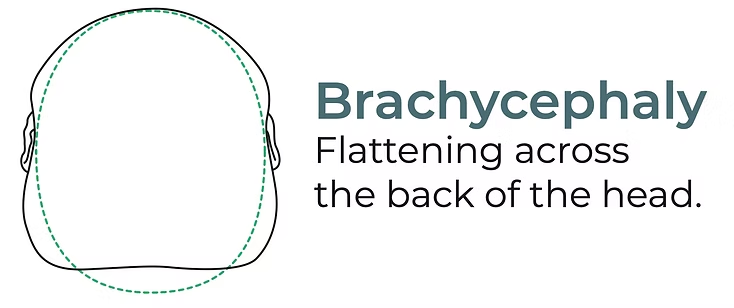
Brachycephaly is a descriptive term for a head that is relatively wide from side to side compared with its front-to-back length. With positional or deformational brachycephaly, the back of the head is often flattened more evenly than it is with a one-sided flat spot. The skull has not simply stopped growing; its proportions have developed differently while the infant skull is flexible.
Parents may say their baby's head is flat in back or looks wider than expected. Those observations are worth sharing, but they do not establish what caused the shape. Birth molding, family head-shape variation, positioning, growth, and less common medical conditions can look different from baby to baby. For a broader starting point, see Is My Baby's Head Shape Normal?
What does brachycephaly look like?
From above, the head may look proportionally broad from side to side and shorter from the forehead to the back. The flattening is often relatively even rather than concentrated on one side. From behind, parents may notice a flatter line across the back and sometimes prominence above the ears. From the side, the back may look less rounded than expected.
Hair, camera angle, lighting, and how a baby is held can change the appearance. A provider evaluates the entire head, face, sutures, growth pattern, neck movement, and medical history rather than relying on a photo or one visual feature.
Brachycephaly vs. plagiocephaly
Brachycephaly
More symmetric flattening across the back, with a relatively wider and shorter overall head shape.
Plagiocephaly
Asymmetric flattening, typically more prominent on one side, sometimes with associated differences in ear or forehead position.
The patterns can occur together, and visual observation does not establish a diagnosis. Learn more in Plagiocephaly in Babies: A Parent's Guide.
What causes positional brachycephaly?
A young baby's skull is naturally flexible and grows rapidly. Repeated pressure across the back can influence its developing proportions. This may be more likely when an infant spends substantial time with the head resting in the same general position or has limited opportunities for varied movement while awake.
Other contributing factors may include prematurity, limited mobility, positioning before or around birth, multiple birth, prolonged medically necessary positioning, and some health or developmental needs. A head-turning preference or torticollis is more often associated with one-sided flattening, but neck movement should still be evaluated because babies can have combined shape patterns. Contributing factors do not mean a parent caused the shape.
How is brachycephaly measured?
Cranial Index (CI), also called Cephalic Index, describes head width relative to front-to-back length. A cranial index baby measurement turns that proportion into a number, which can make head shape easier to document consistently than visual memory alone. Providers may also evaluate diagonal measurements because brachycephaly and plagiocephaly can occur together.
CI does not explain why a head has its shape, establish a diagnosis, or decide treatment. Methods and interpretation systems vary, and measurements should be considered with the full clinical examination. This article intentionally does not repeat formulas, thresholds, or interpretation tables.
Learn how baby head shape is measuredFor the site's existing CI and CVAI interpretation guidance, visit Understanding Your SoftSpot® Report.
Is there a brachycephaly severity scale?
Not a single universal one. The widely shared five-level severity scale from Children's Healthcare of Atlanta grades plagiocephaly, the one-sided pattern, using the Cranial Vault Asymmetry Index (CVAI). Brachycephaly is usually described with Cranial Index instead, and clinics, studies, and measurement devices group CI results in different ways.
Alongside the number, clinicians look for physical signs that the whole head shape has been affected, such as prominence of the forehead on both sides, a taller back of the skull, or widening above both ears. Age, head growth, change over time, and whether plagiocephaly is present too are part of the same assessment. A category from one scale or device should not be compared directly with another, and no severity label on its own decides whether a baby needs repositioning, physical therapy, or a helmet.
Can brachycephaly improve as a baby grows?
Some positional flattening improves as babies grow, gain head control, sit, roll, and spend less awake time resting against the back of the head. The amount and pace of change differ among children. No one can promise spontaneous correction or a particular result based on age, appearance, or a single measurement.
During awake and supervised time, regular tummy time gives the back of the head a break and supports neck, shoulder, and trunk development. Parents can also alternate arms during feeding and holding, encourage looking in different directions, and limit unnecessary awake time in car seats, swings, and other devices that place pressure on the back of the head.
Our step-by-step guide to helping a flat head without a helmet covers these approaches in more detail. These general strategies do not replace assessment. If movement seems limited or the shape is persistent or progressing, a provider may recommend clinical follow-up, physical therapy where appropriate, or another individualized plan. Continue placing the baby on the back for all sleep.
Does brachycephaly mean my baby needs a helmet?
No. Brachycephaly does not automatically mean helmet therapy is required. Treatment decisions may consider the baby's age, head growth, overall shape, measurements, progression, contributing factors, examination findings, and response to conservative approaches.
A specific CI value should not be treated as an automatic helmet recommendation. Evidence, eligibility criteria, and clinical practice can vary. A qualified healthcare provider should discuss observation, positioning, physical therapy, specialty evaluation, or cranial orthosis options with the family when appropriate.
When should parents talk to a healthcare provider?
Bring up a flat back of the baby's head at a well-child visit, even if you are unsure whether the shape falls within natural variation. Contact the provider if flattening persists or progresses, neck movement seems limited, the baby has a strong head preference, or you have any concern about head growth, movement, feeding, or development.
Positional brachycephaly is different from craniosynostosis, in which one or more skull sutures close too early and alter skull growth. Parents cannot reliably distinguish all head-shape conditions at home. A professional can examine the skull and sutures, evaluate the head from several views, review growth and history, and decide whether follow-up, therapy, imaging, or referral is appropriate.
Measuring and tracking head shape
Looking at a baby's head can help parents notice a possible difference, but photographs and memory are affected by angle, hair, lighting, and growth. Objective measurement can document head width relative to length and side-to-side asymmetry using a consistent method. Repeated measurements can provide a record of how proportions change over time.
Measurement remains only one part of the picture. Results are most useful when shared with a child's healthcare provider and interpreted alongside age, examination, growth, movement, and medical history.
Frequently asked questions
What is brachycephaly?
Brachycephaly describes a head shape that is proportionally wider and shorter from front to back. Positional or deformational brachycephaly commonly includes relatively even flattening across the back of a baby’s head from external pressure.
What causes a baby's head to become flat in the back?
A young infant’s skull is flexible, and repeated pressure on the back can contribute to flattening. Limited mobility, time spent with the head in one position, prematurity, positioning before or around birth, and some medical needs can also contribute. A healthcare provider can evaluate the complete picture.
How can I tell the difference between brachycephaly and plagiocephaly?
Brachycephaly usually looks more evenly flat across the back and proportionally wider. Plagiocephaly is asymmetric, with greater flattening on one side and possible differences in ear or forehead position. Appearance alone cannot confirm a diagnosis.
Can brachycephaly improve as my baby grows?
Some positional flattening improves as a baby grows, develops head control, becomes more mobile, and spends less awake time resting on the same area. Outcomes vary, so parents should not assume a particular amount of correction. A provider can recommend appropriate follow-up.
How is brachycephaly measured?
Cranial Index, also called Cephalic Index, relates head width to front-to-back length. Clinicians may also examine the head from multiple views and consider asymmetry measurements, growth, age, neck movement, and medical history.
What is Cranial Index?
Cranial Index, or CI, is a numerical description of head width relative to head length. A relatively wider, shorter head has a higher width-to-length proportion. CI is a measurement, not a diagnosis or treatment decision.
Is there a severity scale for brachycephaly?
There is no single universal brachycephaly scale. The commonly shared five-level plagiocephaly scale grades one-sided asymmetry using CVAI, while brachycephaly is usually described with Cranial Index, which clinics and devices group differently. A severity label alone does not determine treatment.
Does brachycephaly always require a helmet?
No. Brachycephaly does not automatically require helmet therapy. Treatment decisions depend on the baby’s age, growth, examination, measurements, progression, contributing factors, and response to conservative care and should be made with a qualified healthcare professional.
When should I be concerned about a flat back of my baby's head?
Discuss persistent, progressive, or unusual flattening with your baby’s healthcare provider. Seek advice if neck movement is limited, the baby strongly prefers one direction, you feel an unusual ridge, or you have concerns about head growth, movement, feeding, or development.
References
- American Academy of Pediatrics, HealthyChildren.org. When a Baby's Head Is Misshapen: Positional Skull Deformities.
- Johns Hopkins Medicine. Deformational Plagiocephaly.
- Linz C, et al. Positional Skull Deformities: Etiology, Prevention, Diagnosis, and Treatment. Deutsches Ärzteblatt International. 2017.
- van Vlimmeren LA, et al. Methods to Diagnose, Classify, and Monitor Infantile Deformational Plagiocephaly and Brachycephaly: A Narrative Review. Journal of Chiropractic Medicine. 2015.
- U.S. Food and Drug Administration. 510(k) Summary K212045: SoftSpot Cranial Measurement Software.