Parent helmet therapy guide
Does My Baby Need a Helmet for Flat Head?
A flat or asymmetric head does not automatically mean a baby needs a helmet. This guide explains when a cranial helmet may be considered and how age, growth, measurements, progress, and clinical evaluation fit into that decision.
Reviewed by the SoftSpot Clinical & Scientific Team
What is helmet therapy?
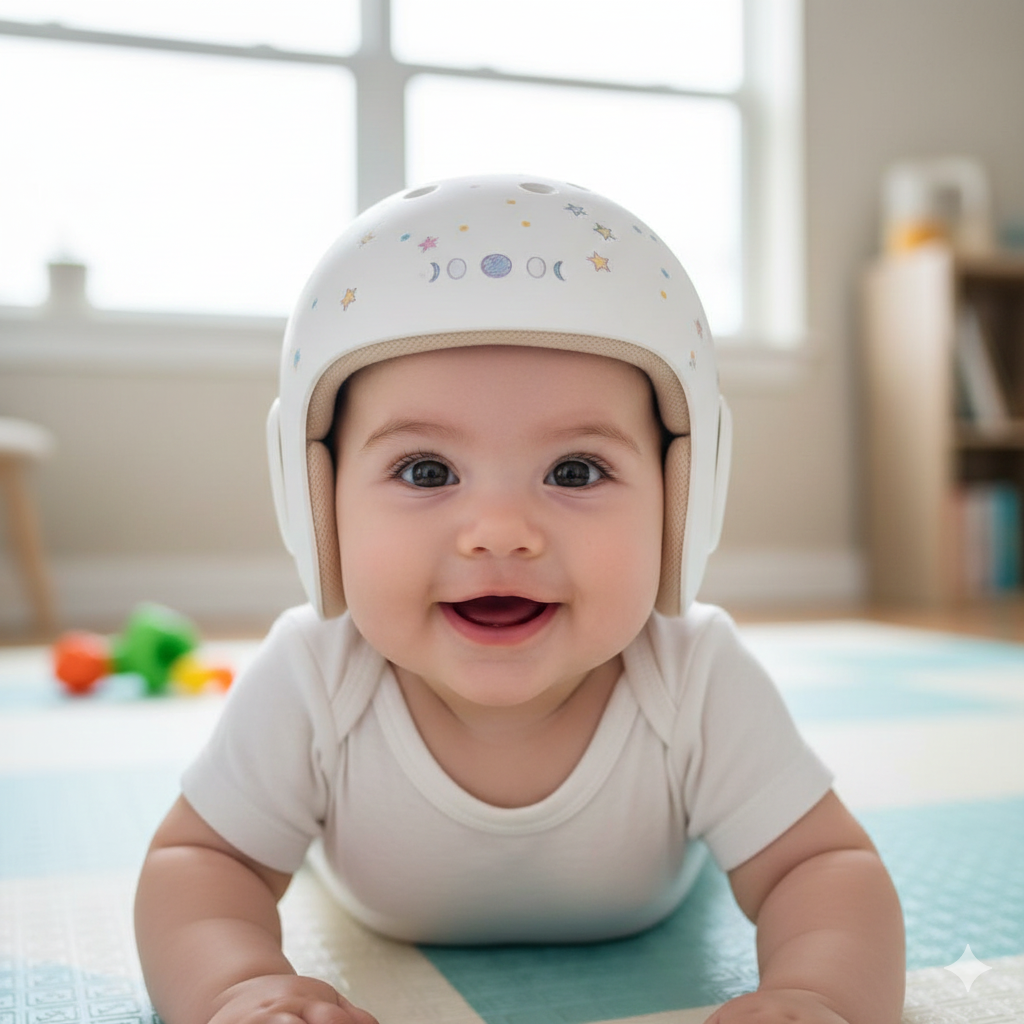
Helmet therapy uses a custom cranial remolding orthosis made for an infant's head. The orthosis provides space where growth is desired and gentle contact in other areas so that natural skull growth is guided toward a more balanced shape. It does not squeeze the brain or forcibly push the skull into shape.
An orthotist or another trained specialist takes measurements or a scan, creates the custom fit, and checks it regularly as the baby grows. Helmet therapy for a positional skull deformity is different from helmets sometimes used after surgery for craniosynostosis. If you are first learning about a flat spot, start with Is My Baby's Head Shape Normal?
Why do some babies get helmets while others don't?
The answer is individualized because “flat head” includes different patterns and degrees of difference. A clinician may consider whether the baby has asymmetric plagiocephaly, a relatively wide and short brachycephalic head shape, or a combination.
- the type and degree of asymmetry or flattening
- the baby's age and remaining period of rapid skull growth
- whether the head shape is stable, improving, or progressing
- response to repositioning or physical therapy when appropriate
- torticollis, restricted neck motion, or other contributing factors
- the complete clinical examination and family discussion
Two babies with similar-looking photographs may receive different recommendations because their ages, growth patterns, measurements, movement, history, and progress differ. A picture or online checklist cannot replace an examination.
Mild vs. moderate vs. severe flat head
Clinicians and researchers may describe positional head-shape differences as mild, moderate, or severe using clinical features, objective measurements, or both. Cranial Index can describe width relative to length, while CVA and CVAI can quantify side-to-side asymmetry. Classification systems, landmarks, and thresholds vary among clinics, devices, and published studies.
A severity label or measurement category does not independently determine whether a plagiocephaly helmet or brachycephaly helmet is appropriate. Age, change over time, movement, prior care, and the full evaluation also matter. Read How Is a Baby's Head Shape Measured? and use Understanding Your SoftSpot® Report for the site's existing CI/CVAI interpretation guidance.
Why does age matter for helmet therapy?
A cranial remolding orthosis works with skull growth, which is especially rapid during infancy and slows with age. That is why baby helmet age enters the clinical discussion. In general, earlier treatment during an appropriate growth period may progress differently from treatment started later, and later treatment may require more time.
There is not one universal birthday by which every baby must begin or after which every baby cannot benefit. AAP parent guidance and CNS guidelines discuss age together with persistence, degree of deformity, and response to conservative care. The CNS helmet recommendations are Level II, reflecting uncertain clinical certainty. Individual circumstances, including prematurity and corrected age, can affect timing, so a qualified provider should interpret published guidance for the child.
Why Early Recognition Matters
A large retrospective study reviewed 25,322 children diagnosed with positional plagiocephaly over 10 years at five Southern California hospitals associated with Kaiser Permanente. Researchers compared children diagnosed by 6 months of age with those diagnosed after 6 months.
2.63×
Children diagnosed after 6 months were 2.63 times as likely to be referred for a helmet therapy evaluation.
1.64×
Children diagnosed after 6 months were 1.64 times as likely to require helmet therapy.
This finding shows an association, not cause and effect. Because the study was observational and retrospective, it does not prove that earlier recognition itself prevents helmet therapy. Babies diagnosed later may differ in prematurity, medical history, access to evaluation, initial head shape, or other factors that also influence care.
The practical message is to notice concerns, document changes objectively when appropriate, and discuss persistent head-shape differences with a healthcare provider in a timely way. Early recognition creates an opportunity for evaluation and monitoring; it does not guarantee that a helmet will be avoided or needed.
What may be tried before helmet therapy?
Depending on the baby's age, head shape, movement, and clinical findings, a provider may recommend conservative approaches first. These can include varied positioning during awake time, directly supervised tummy time, alternating sides during holding or feeding, and reducing unnecessary awake time in devices that place prolonged pressure on the same area.
These conservative approaches are covered step by step in helping a baby's flat head without a helmet. A strong turning preference, head tilt, or limited neck movement may warrant evaluation for torticollis. Pediatric physical therapy may be appropriate when prescribed and can address movement limitations as well as teach safe, individualized positioning and exercises.
How is head shape measured before considering a helmet?
Objective measurements put numbers to overall head proportions and asymmetry. Cranial Index, or CI, compares width with front-to-back length. Cranial Vault Asymmetry Index, or CVAI, describes left-to-right asymmetry using diagonal dimensions. Providers may obtain measurements with calipers, surface imaging, or another validated method.
Numbers can help characterize and follow head shape, but they cannot identify every cause, replace examination of the sutures and neck, or make a helmet decision alone. Clinics that fit cranial helmets often use three-dimensional head scanning, and some offer an initial scan or consultation at no cost. If you are weighing an evaluation, it is reasonable to ask a clinic what an initial visit involves and whether there is a charge before booking.
Learn how baby's head shape is measuredCan objective tracking help?
Repeated measurements captured with a consistent method can document whether head proportions or asymmetry are changing over time. That record may help parents and clinicians discuss whether a shape is improving, staying similar as the head grows, or needs further evaluation. Tracking is more consistent than comparing casual photographs taken from different angles.
Objective does not mean diagnostic. A trend still needs to be interpreted with the baby's age, growth, physical examination, neck movement, history, and any care already tried.
What happens if my baby is prescribed a helmet?
A trained specialist measures or scans the baby's head and makes a custom orthosis. The family receives a wear schedule, cleaning and skin-care instructions, and guidance about what to watch for. Regular wear is generally important for the prescribed plan, but families should follow their own clinical team's directions rather than a schedule found online.
Follow-up visits allow the specialist to check skin, fit, growth, and head-shape progress and adjust the helmet as needed. Treatment duration varies with the child's age, growth rate, starting shape, progress, and clinical plan. Contact the helmet provider about fit concerns, persistent redness, discomfort, odor, or other problems rather than modifying the orthosis at home.
When should I talk to my baby's healthcare provider?
Ask about head shape at a well-child visit if a flat area persists, appears significant, progresses, or worries you. Seek advice if your baby strongly favors one direction, has limited neck movement or a persistent head tilt, or if you notice an unusual ridge or have concerns about head growth, feeding, movement, or development.
Positional plagiocephaly and brachycephaly are different from craniosynostosis, in which one or more skull sutures close too early. A healthcare professional can examine the sutures and head from multiple views, review history and growth, and decide whether observation, physical therapy, imaging, referral, or another plan is appropriate. A helmet for positional flattening does not treat craniosynostosis itself.
Frequently asked questions
Does every baby with a flat head need a helmet?
No. Many babies with positional flattening do not need helmet therapy. A provider considers the type and degree of head-shape difference, age, growth, progression, contributing factors, response to conservative care, and the complete clinical evaluation.
How do doctors decide if a baby needs a helmet?
Clinicians may examine the skull and sutures, assess the head from multiple views, review age and growth, evaluate neck movement, and consider objective measurements and change over time. No single observation or measurement makes the decision independently.
At what age is helmet therapy considered?
Helmet therapy is used during infancy while the skull is actively growing. Starting age and likely benefit depend on the individual baby, head shape, growth, prior management, and clinical circumstances. Published guidance does not create one rigid cutoff for every child.
Can plagiocephaly improve without a helmet?
Some positional plagiocephaly improves with growth, increased mobility, varied awake positioning, supervised tummy time, and physical therapy when clinically appropriate. Progress varies, so a provider should assess persistent or significant asymmetry.
Can brachycephaly require a helmet?
Helmet therapy may be considered for selected babies with brachycephaly, but brachycephaly does not automatically require one. Age, proportions, progression, examination, and response to other approaches are among the factors a healthcare professional may consider.
How is flat-head severity measured?
Providers may use clinical examination plus measurements such as Cranial Index, Cranial Vault Asymmetry, and CVAI. Techniques and classification systems vary, so a category needs clinical context and does not independently determine treatment.
What CI or CVAI means my baby needs a helmet?
There is no single CI or CVAI value that independently determines whether a baby needs a helmet. Measurement methods and classifications vary, and treatment decisions also consider age, growth, examination, progression, contributing factors, and response to conservative care.
How long do babies usually wear helmets?
Treatment duration varies by child and depends on age at the start, skull growth, head shape, progress, and the prescribed plan. A helmet specialist monitors fit and progress and adjusts the orthosis during follow-up.
Can SoftSpot tell me whether my baby needs a helmet?
No. SoftSpot is a measurement tool, not a diagnostic or treatment-decision tool. SoftSpot can objectively measure and track head shape, and those measurements can be discussed with a qualified healthcare provider.
References
- American Academy of Pediatrics, HealthyChildren.org. Baby Helmet Therapy: Parent FAQs.
- American Academy of Pediatrics, HealthyChildren.org. When a Baby's Head Is Misshapen: Positional Skull Deformities.
- Congress of Neurological Surgeons. The Role of Cranial Molding Orthosis (Helmet) Therapy. Guidelines for Positional Plagiocephaly. 2016.
- Linz C, et al. Positional Skull Deformities: Etiology, Prevention, Diagnosis, and Treatment. Deutsches Ärzteblatt International. 2017.
- Munabi CO, Nelson MS, Francis SH. Risk Factors for Delayed Diagnosis of Positional Plagiocephaly: A Review of 25,322 Patients. Cleft Palate Craniofac J. 2024;61(10):1679-1686. PMID: 37248557.
- U.S. Food and Drug Administration. 510(k) Summary K212045: SoftSpot Cranial Measurement Software.